



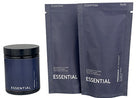


Collagen+
60 Non-vegan capsules per bottle

Hair

Skin

Nails

Joints
-
Type I marine collagen peptides — optimised for absorption
-
Hyaluronic Acid with iodine from PureSea® Seaweed
-
With added Vitamin C, E, and Biotin
-
Certified sustainability with Naticol® and Friend of the Sea for responsible sourcing.
-
Tested for purity, including heavy metals such as mercury, lead, and cadmium
- 30-day supply with refills delivered monthly.
- Pause or cancel anytime.
We stand by our science — enjoy 90 days risk-free. Read more


1 capsule typically provides:
Per Portion - *NRV
- Vitamin E - 5mg a-TE - 42%NRV*
- Vitamin C - 20mg - 25% NRV*
- Biotin - 900µg - 1800% NRV*
- Marine Collagen - 500mg
- Seaweed (Algae) - 50mg
- Providing Natural Iodine - 33µg - 22% NRV*
- Hyaluronic Acid - 50mg
* NRV = Nutrient Reference Value
Ingredients
Ingredients:
Marine Collagen(Fish), Capsule Shell: Hydroxypropyl Methylcellulose, Hyaluronic Acid (as Sodium Hyaluronate), Seaweed Ascophyllum nodosum, Vitamin C (as Ascorbic Acid), Vitamin E (as D-Alpha Tocopherol Acid Succinate(Soya)), Biotin (as D-Biotin), Bulking Agent: Rice Bran.
Allergens
Allergens:
For allergens see ‘Ingredients’ in bold. Although rigorous precautions are taken to prevent any cross-contamination, this product is manufactured in a facility that handles allergy-based materials.
Disclaimer
Disclaimer:
Always consult your health practitioner before taking nutritional supplements, especially if you are taking medication or are under medical supervision. Not recommended for children, pregnant or lactating women. You should not take supplements as a substitute for a varied balanced diet or healthy lifestyle. Store in a cool dry place, out of reach of children. Not suitable for vegans or vegetarians.
Take 1 capsule per day, with a glass of water or a meal.
Do not exceed recommended dose.
Take 1 capsule daily with food and a glass of water.
For best absorption, we recommend taking it with a meal that contains a little healthy fat, this helps your body make the most of the fat-soluble nutrients like vitamin E and marine collagen.
Stay consistent and try to take it at the same time each day. This helps build a routine and support long-term benefits.
Delivery time begins after the carrier receives your package.
 Collagen+
The Persona
Promise
Discover what makes us different and why our customers trust us.


At Persona we don't use marketing claims.
Every health benefit you see is approved by european authorities and backed by science.
It's how we build trust.
Collagen production naturally slows down as we age. Leaving the skin less firm and radiant than before. Collagen+ combines high-purity marine collagen peptides with Vitamin C, Biotin, Hyaluronic Acid, and PureSea® seaweed that provides trace minerals for your body.
- Vitamin C contributes to normal collagen formation for the normal function of skin.*
- Biotin contributes to the maintenance of normal hair, skin and nails.*
- Vitamin E contributes to the protection of cells from oxidative stress.*
- Iodine contributes to the maintenance of normal skin.*
- Copper contributes to normal hair pigmentation.*
- Hyaluronic Acid is included as a supporting nutrient.
Healthy movement and flexibility depend on the strength of your connective tissues. Collagen+ provides marine collagen peptides, that are naturally rich in amino acids like glycine, proline, and hydroxyproline — the very components of cartilage, tendons, and ligaments.
- Vitamin C contributes to normal collagen formation for the normal function of cartilage.*
- Vitamin C contributes to normal collagen formation for the normal function of bones.*
- Vitamin C contributes to normal collagen formation for the normal function of blood vessels.*
- Marine collagen peptides provide amino acids naturally found in connective tissue.
Environmental stress, lifestyle, and age can all create challenges. Collagen+ includes antioxidant Vitamin E, Vitamin C, and trace minerals from seaweed. Sustainably sourced from fish and seaweed from the pristine waters of the Scottish Outer Hebrides, each ingredient is rigorously tested for quality, purity and safety.
- Vitamin E contributes to the protection of cells from oxidative stress.*
- Vitamin C contributes to the protection of cells from oxidative stress.*
- Vitamin C contributes to normal energy-yielding metabolism.*
- Iodine contributes to normal cognitive function.*
- Iodine contributes to normal energy-yielding metabolism.*
Understanding Bioavailability
Why the form of a vitamin matters as much as the vitamin itself
The Restaurant Example
Imagine ordering salmon at a restaurant. The menu says "salmon", but what arrives could be perfectly grilled, raw, or still wrapped in plastic. Technically all salmon, but only one is actually nourishing.
Vitamins work the same way. A label might say "Vitamin C 1000 mg," but that vitamin could be in a form your body barely absorbs, or one it uses efficiently. The form determines whether your body can actually use what you're taking.
What Is Bioavailability?
Bioavailability is the amount of a nutrient that actually enters your bloodstream and reaches your cells.
If you take 100 mg of a vitamin but only 20 mg gets absorbed, the bioavailability is 20%. The rest passes through unused.
What affects bioavailability:
- The chemical form of the vitamin
- Your individual gut health and genetics
- What you eat alongside the supplement
Common Vitamin Forms Explained
Methylated Vitamins (Active Forms)
Some people struggle to convert standard vitamins into their active, usable forms due to genetic variations. Methylated vitamins skip that step; they're already active.
Example: Methylcobalamin (B12) vs Cyanocobalamin
- Methylcobalamin Active form, immediately usable
- Cyanocobalamin Synthetic, requires conversion (which 40-60% of people struggle with due to MTHFR gene variants)
Common forms: Methylfolate (5-MTHF), methylcobalamin (B12), P-5-P (B6)
Natural vs Synthetic
"Natural" doesn't automatically mean better; it depends on the specific vitamin.
Example: Vitamin E
- Natural (d-alpha-tocopherol): Derived from plants, more biologically active
- Synthetic (dl-alpha-tocopherol): Contains 8 forms, only one your body prefers
Example: Vitamin C
- Ascorbic acid (synthetic) is molecularly identical to natural vitamin C and equally effective
- Liposomal vitamin C: Wrapped in fat bubbles for enhanced absorption and higher blood levels
Fat-Soluble vs Water-Soluble
Fat-soluble vitamins (A, D, E, K) need fat to be absorbed. Taking them with food containing healthy fats significantly improves uptake.
Water-soluble vitamins (B, C) dissolve in water and are absorbed more easily, but excess is excreted quickly, making sustained-release forms sometimes beneficial.
What "Bioavailable" Actually Means on a Label
When we say "bioavailable form," we mean:
- Active forms that don't require conversion (methylated B vitamins)
- Forms with proven absorption backed by scientific research
- Enhanced delivery systems (like liposomal technology)
What it shouldn't mean: vague marketing language without specifics.
Red flags to watch for:
- No specific form listed (just "Vitamin B12" without the type)
- "Proprietary blends" that hide ingredient amounts
- Claims without any absorption data
The Bottom Line
A cheaper supplement with poor bioavailability isn't a bargain. The best supplements aren't about taking more; they're about absorbing what you take.
What to look for:
- Specific forms clearly listed on the label
- Science-backed forms (methylated, chelated, liposomal)
- Transparency about dosages and sources
At Persona, we choose forms based on scientific evidence for absorption, not what's cheapest to manufacture. Because if your body can't use it, what's the point?
References: EFSA scientific opinions on bioavailability; NIH Office of Dietary Supplements; peer-reviewed studies on vitamin absorption and forms (available upon request).


From Ocean to Capsule Transparent & Tested

Type I Marine Collagen
Sustainably sourced Hydrolyzed Collagen with ≥90% protein content, excellent bioavailability

With PureSea® Seaweed
Sustainably harvested from Scotland, natural source of iodine, with DNA-verified purity and traceability.

5 Combined Ingredients
Hyaluronic acid, Biotin and Vitamin A, C for hair, skin & nails support.

Naticol® Sustainability
Verified by Friend of the Sea for responsible sourcing, tested for purity and heavy metals.
More than just Supplements
Bioavailable Nutrients

How to Use:
- Take 1 capsule per day, with a glass of water or a meal.

The Benefits of Vitamin E
Bioavailable form
Vitamin E is a fat-soluble antioxidant that protects cell membranes from oxidative damage. It plays an important role in immune function, skin health, and cellular protection. As a key defender of the body's lipid structures, vitamin E works alongside vitamin C to provide comprehensive antioxidant coverage.
Key Highlights
- Contributes to the protection of cells from oxidative stress (EFSA approved)
- Fat-soluble antioxidant that protects cell membranes
- Works synergistically with vitamin C for comprehensive antioxidant coverage
- May reduce CRP (inflammatory marker) in those with elevated levels
- Supports skin health and barrier function
- No increase in mortality risk at standard supplementation levels
Biochemistry Timeline
Vitamin E is fat-soluble and stored in body fat and the liver, meaning it takes time to build up to optimal levels. Blood levels typically increase within 2 to 4 weeks of supplementation, while anti-inflammatory benefits (CRP reduction) were more pronounced with longer supplementation periods.
For skin-related benefits, consistent supplementation over 8 to 12 weeks is recommended. Vitamin E is best absorbed when taken with a meal containing dietary fat.
Hormonal Health and PCOS
Emerging research suggests that vitamin E may offer benefits for women with polycystic ovary syndrome (PCOS). A study by Karandish et al. (2022, Scientific Reports) found that vitamin E, alone or in combination with omega-3 and magnesium, reduced triglycerides, VLDL, LDL, hs-CRP, and hirsutism in women with PCOS.
These findings suggest that vitamin E may support metabolic and hormonal parameters in PCOS, though more research is needed. It works best as part of a comprehensive approach alongside lifestyle changes, diet, and appropriate medical care.
Menopausal Support
A 2023 review (Barcikowska et al., Nutrients) found that vitamin E may influence several aspects of menopausal health, including hot flashes, vascular health, lipid profiles, and vaginal changes. The review suggested vitamin E as a potential option when hormone replacement therapy (HRT) is contraindicated.
While vitamin E is not a replacement for HRT when clinically indicated, it may offer gentle support for some menopausal symptoms as part of a broader approach to well-being during this transition. Individual responses vary, and medical guidance should be sought for significant symptoms.
Summary
Vitamin E is a fat-soluble antioxidant that protects cell membranes from oxidative damage and works synergistically with vitamin C. It is important for cellular protection, skin health, and may support anti-inflammatory processes, hormonal balance, and menopausal comfort.
Research confirms no mortality risk at standard doses and meaningful CRP reduction in those with elevated inflammation. Vitamin E is best taken with food containing fat, and benefits develop over 4 to 12 weeks of consistent use.
FAQs
How much vitamin E do I need?
The recommended daily intake for adults in the EU is 12 mg (approximately 18 IU) of alpha-tocopherol. The European upper limit for supplementation is 300 mg per day. Most supplements provide 100-400 IU per day.
Can I get enough vitamin E from food?
A diet rich in nuts, seeds, and healthy oils can provide adequate vitamin E for many people. However, those with low-fat diets, absorption issues, or increased antioxidant needs may benefit from supplementation.
Is there a risk of taking too much?
At standard supplementation levels, vitamin E is safe and well-tolerated. Very high doses (above 800 IU/day) have been debated in research but a 2014 meta-analysis found no increase in mortality at doses up to 800 IU/day.
Should I take natural or synthetic vitamin E?
Natural vitamin E (d-alpha-tocopherol) is more bioavailable than synthetic (dl-alpha-tocopherol). When reading labels, look for the "d-" prefix, which indicates the natural form.
Is vitamin E safe during pregnancy?
Vitamin E is important during pregnancy for its antioxidant properties. Standard recommended amounts are considered safe. Consult your healthcare provider for personalised guidance.
Research
Amin AM et al. – Nutrition research (New York, N.Y.) (2026). [Systematic review]. https://pubmed.ncbi.nlm.nih.gov/41418497/
Tan et al — PeerJ (2026). [Meta-Analysis]. https://doi.org/10.7717/peerj.20744
Christopher et al — J Acad Nutr Diet (2026). [Randomized Controlled Trial]. https://doi.org/10.1016/j.jand.2026.156299
Ismail YA et al. – BMC neurology (2025). [Systematic review]. https://pubmed.ncbi.nlm.nih.gov/39939901/
Song et al — Cell Rep Med (2025). [Randomized Controlled Trial]. https://doi.org/10.1016/j.xcrm.2025.101939
Gaffney et al — Laryngoscope (2025). [Meta-Analysis]. https://doi.org/10.1002/lary.31902
Solmi et al — Mol Psychiatry (2025). [Meta-Analysis]. https://doi.org/10.1038/s41380-024-02733-z
Widyasanti et al — Open Vet J (2025). [Meta-Analysis]. https://doi.org/10.5455/OVJ.2025.v15.i7.31
Yousefi-Nodeh H et al. – Health care for women international (2024). [RCT]. https://pubmed.ncbi.nlm.nih.gov/36053717/
Malandris K et al. – Journal of gastroenterology and hepatology (2024). [Systematic review]. https://pubmed.ncbi.nlm.nih.gov/38627972/
Chee NM et al. – Journal of gastroenterology and hepatology (2024). [Systematic review]. https://pubmed.ncbi.nlm.nih.gov/39150005/
Wen H et al. – The Cochrane database of systematic reviews (2024). [Systematic review]. https://pubmed.ncbi.nlm.nih.gov/39412049/
Wang Y et al. – Drugs (2024). [Systematic review]. https://pubmed.ncbi.nlm.nih.gov/38478331/
Didangelos et al — Nutrients (2024). [Randomized Controlled Trial]. https://doi.org/10.3390/nu16183045
Posnakidis et al — Nutrients (2024). [Randomized Controlled Trial]. https://doi.org/10.3390/nu16172914
Quah et al — Oral Dis (2024). [Meta-Analysis]. https://doi.org/10.1111/odi.14902
Sen et al — Int J Obes (Lond) (2024). [Randomized Controlled Trial]. https://doi.org/10.1038/s41366-024-01472-z
Watling et al — Hepatology (2024). [Meta-Analysis]. https://doi.org/10.1097/HEP.0000000000000819
Izadi et al — BMC Womens Health (2024). [Randomized Controlled Trial]. https://doi.org/10.1186/s12905-024-02980-w
Shan et al. — Nutrients (MDPI) (2023). [Umbrella review (32 MAs, 64 outcomes)]. https://www.mdpi.com/2072-6643/15/15/3301
Barcikowska et al. — Nutrients (2023). [Systematic review (16 studies)].
Linus Pauling Institute / NIH - Micronutrient Information Center (2023). [Expert Review]. Safety/Dosing
Vogli S et al. – Nutrients (2023). [Meta-analysis]. https://pubmed.ncbi.nlm.nih.gov/37686767/
Ghasemi S et al. – BMC oral health (2023). [Meta-analysis]. https://pubmed.ncbi.nlm.nih.gov/38042793/
Ni C et al. – Molecular nutrition & food research (2023). [Meta-analysis]. https://pubmed.ncbi.nlm.nih.gov/37726247/
Wang MY et al. – Journal of digestive diseases (2023). [Meta-analysis]. https://pubmed.ncbi.nlm.nih.gov/37503812/
Gu Y et al. – Expert review of gastroenterology & hepatology (2023). [Systematic review]. https://pubmed.ncbi.nlm.nih.gov/36689199/
Musazadeh et al — Int J Vitam Nutr Res (2023). [Meta-Analysis]. https://doi.org/10.1024/0300-9831/a000757
Zhou et al — Eur Geriatr Med (2023). [Meta-Analysis]. https://doi.org/10.1007/s41999-022-00720-7
Peña-Corona et al — Int J Mol Sci (2023). [Meta-Analysis]. https://doi.org/10.3390/ijms241914930
Karandish et al. — Sci Rep (2022). [Meta-analysis (10 RCTs)].
Salmani et al. — Clin Nutr ESPEN (2022). [Systematic review & MA].
Ahmad et al. — Sci Rep (2022). [Systematic review & MA (12 RCTs)].
Feduniw S et al. – Nutrients (2022). [Systematic review]. https://pubmed.ncbi.nlm.nih.gov/36615817/
Poonyam P et al. – Asian Pacific journal of cancer prevention : APJCP (2022). [Meta-analysis]. https://pubmed.ncbi.nlm.nih.gov/36172650/
Power et al — Clin Nutr (2022). [Randomized Controlled Trial]. https://doi.org/10.1016/j.clnu.2021.12.004
Ren et al — Eur Neurol (2022). [Meta-Analysis]. https://doi.org/10.1159/000525045
Tefagh et al — Sci Rep (2022). [Meta-Analysis]. https://doi.org/10.1038/s41598-022-09082-3
Zhao et al — Circulation (2022). [Meta-Analysis]. https://doi.org/10.1161/CIRCULATIONAHA.121.057642
Xu et al — Am J Clin Nutr (2022). [Randomized Controlled Trial]. https://doi.org/10.1093/ajcn/nqac013
Wang J et al. – Oxidative medicine and cellular longevity (2021). [Meta-analysis]. https://pubmed.ncbi.nlm.nih.gov/34616506/
Ashley S et al. – Nutritional neuroscience (2021). [Meta-analysis]. https://pubmed.ncbi.nlm.nih.gov/31661399/
Vadarlis A et al. – Journal of gastroenterology and hepatology (2021). [Meta-analysis]. https://pubmed.ncbi.nlm.nih.gov/32810309/
Lin M et al. – Clinics and research in hepatology and gastroenterology (2021). [Meta-analysis]. https://pubmed.ncbi.nlm.nih.gov/33272889/
Amini et al — Pain Res Manag (2021). [Randomized Controlled Trial]. https://doi.org/10.1155/2021/5529741
Wimmers et al — Cell (2021). [Randomized Controlled Trial]. https://doi.org/10.1016/j.cell.2021.05.039
Pham et al — Gut Microbes (2021). [Randomized Controlled Trial]. https://doi.org/10.1080/19490976.2021.1875774
Bozhedomov et al — Urologiia (2021). [Randomized Controlled Trial]. https://pubmed.ncbi.nlm.nih.gov/33818939/
Asbaghi et al. — Scientific Reports (Nature) (2020). [Meta-analysis (26 RCTs)]. https://www.nature.com/articles/s41598-020-73741-6
Asbaghi O et al. - Clinical Nutrition ESPEN (2020). [Meta-Analysis]. https://pubmed.ncbi.nlm.nih.gov/32085897/
Ataei-Almanghadim K et al. – Complementary therapies in medicine (2020). [RCT]. https://pubmed.ncbi.nlm.nih.gov/31987231/
Rattanawiwatpong et al — J Cosmet Dermatol (2020). [Randomized Controlled Trial]. https://doi.org/10.1111/jocd.13305
Endo et al — Influenza Other Respir Viruses (2020). [Randomized Controlled Trial]. https://doi.org/10.1111/irv.12755
Zerbinati et al — Andrologia (2020). [Clinical Trial]. https://doi.org/10.1111/and.13543
Chen et al — BMC Womens Health (2020). [Clinical Trial]. https://doi.org/10.1186/s12905-020-00930-w
Li et al — J Clin Hypertens (Greenwich) (2020). [Randomized Controlled Trial]. https://doi.org/10.1111/jch.13866
Li et al — Eur J Obstet Gynecol Reprod Biol (2020). [Meta-Analysis]. https://doi.org/10.1016/j.ejogrb.2020.02.024
Lewis et al. — Cochrane (2019). [Cochrane systematic review]. https://pubmed.ncbi.nlm.nih.gov/31528965/
Jiang et al — Am J Clin Nutr (2019). [Meta-Analysis]. https://doi.org/10.1093/ajcn/nqy270
Lin et al — Int J Vitam Nutr Res (2019). [Meta-Analysis]. https://doi.org/10.1024/0300-9831/a000553
Hager et al — Arch Gynecol Obstet (2019). [Randomized Controlled Trial]. https://doi.org/10.1007/s00404-019-05194-w
Leng et al — Biosci Rep (2019). [Meta-Analysis]. https://doi.org/10.1042/BSR20193311
Troisi et al — J Ovarian Res (2019). [Clinical Trial]. https://doi.org/10.1186/s13048-019-0500-x
Bo et al — Clin Nutr (2019). [Randomized Controlled Trial]. https://doi.org/10.1016/j.clnu.2017.12.020
Jayedi A et al. – Advances in nutrition (Bethesda, Md.) (2018). [Meta-analysis]. https://pubmed.ncbi.nlm.nih.gov/30239557/
Alipour et al — Nutr Cancer (2018). [Randomized Controlled Trial]. https://doi.org/10.1080/01635581.2018.1446088
Assmann et al — J Nutr (2018). [Randomized Controlled Trial]. https://doi.org/10.1093/jn/nxx061
Shatzel JJ et al. – Journal of thrombosis and haemostasis : JTH (2017). [Review]. https://pubmed.ncbi.nlm.nih.gov/28182323/
Farina N et al. – The Cochrane database of systematic reviews (2017). [Meta-analysis]. https://pubmed.ncbi.nlm.nih.gov/28128435/
Farina N et al. – The Cochrane database of systematic reviews (2017). [Systematic review]. https://pubmed.ncbi.nlm.nih.gov/28418065/
Ahmed et al — Reprod Biol (2017). [Clinical Trial]. https://doi.org/10.1016/j.repbio.2017.05.008
Nouri et al — Gynecol Obstet Invest (2017). [Randomized Controlled Trial]. https://doi.org/10.1159/000452662
Goodman et al — Trials (2016). [Randomized Controlled Trial]. https://doi.org/10.1186/s13063-016-1524-9
Xu W et al. – Journal of neurology, neurosurgery, and psychiatry (2015). [Meta-analysis]. https://pubmed.ncbi.nlm.nih.gov/26294005/
EFSA Panel — EFSA J (2015). [Regulatory opinion].
Abner et al. — Cardiovascular Drugs & Therapy (2014). [Meta-analysis (18 RCTs)]. https://link.springer.com/article/10.1007/s10557-014-6560-7
Rizvi et al. — Int J Prev Med (2014). [Review]. https://pubmed.ncbi.nlm.nih.gov/25489440/
Dysken ME et al. - JAMA (TEAM-AD) (2014). [RCT]. https://pubmed.ncbi.nlm.nih.gov/24381967/
Traber MG - Free Radical Biology and Medicine (2014). [Expert Review]. https://pubmed.ncbi.nlm.nih.gov/24746618/
Gutarra-Vilchez RB et al. – The Cochrane database of systematic reviews (2014). [Meta-analysis]. https://pubmed.ncbi.nlm.nih.gov/25310622/
Lopes da Silva S et al. – Alzheimer's & dementia : the journal of the Alzheimer's Association (2014). [Meta-analysis]. https://pubmed.ncbi.nlm.nih.gov/24144963/
Showell MG et al. – The Cochrane database of systematic reviews (2013). [Systematic review]. https://pubmed.ncbi.nlm.nih.gov/23913583/
Farina N et al. – The Cochrane database of systematic reviews (2012). [Meta-analysis]. https://pubmed.ncbi.nlm.nih.gov/23152215/
Biglia N et al. – Climacteric : the journal of the International Menopause Society (2009). [RCT]. https://pubmed.ncbi.nlm.nih.gov/19415540/
Isaac MG et al. – The Cochrane database of systematic reviews (2008). [Meta-analysis]. https://pubmed.ncbi.nlm.nih.gov/18646084/
Bordeleau L et al. – Clinical therapeutics (2007). [Systematic review]. https://pubmed.ncbi.nlm.nih.gov/17472816/
Ziaei S et al. – Gynecologic and obstetric investigation (2007). [RCT]. https://pubmed.ncbi.nlm.nih.gov/17664882/
Lee et al. — JAMA Cardiol (2005). [Meta-analysis (19 RCTs)]. https://pubmed.ncbi.nlm.nih.gov/15537682/
Miller ER et al. - Annals of Internal Medicine (2005). [Meta-Analysis]. https://pubmed.ncbi.nlm.nih.gov/15668483/
Chertow B – MedGenMed : Medscape general medicine (2004). [Review]. https://pubmed.ncbi.nlm.nih.gov/15647709/
Heck AM et al. – American journal of health-system pharmacy : AJHP : official journal of the American Society of Health-System Pharmacists (2000). [Review]. https://pubmed.ncbi.nlm.nih.gov/10902065/
Tabet N et al. – The Cochrane database of systematic reviews (2000). [Systematic review]. https://pubmed.ncbi.nlm.nih.gov/11034775/
92 studies — Vitamin E
Amin AM et al. – Nutrition research (New York, N.Y.) (2026). [Systematic review]. https://pubmed.ncbi.nlm.nih.gov/41418497/
Tan et al — PeerJ (2026). [Meta-Analysis]. https://doi.org/10.7717/peerj.20744
Christopher et al — J Acad Nutr Diet (2026). [Randomized Controlled Trial]. https://doi.org/10.1016/j.jand.2026.156299
Ismail YA et al. – BMC neurology (2025). [Systematic review]. https://pubmed.ncbi.nlm.nih.gov/39939901/
Song et al — Cell Rep Med (2025). [Randomized Controlled Trial]. https://doi.org/10.1016/j.xcrm.2025.101939
Gaffney et al — Laryngoscope (2025). [Meta-Analysis]. https://doi.org/10.1002/lary.31902
Solmi et al — Mol Psychiatry (2025). [Meta-Analysis]. https://doi.org/10.1038/s41380-024-02733-z
Widyasanti et al — Open Vet J (2025). [Meta-Analysis]. https://doi.org/10.5455/OVJ.2025.v15.i7.31
Yousefi-Nodeh H et al. – Health care for women international (2024). [RCT]. https://pubmed.ncbi.nlm.nih.gov/36053717/
Malandris K et al. – Journal of gastroenterology and hepatology (2024). [Systematic review]. https://pubmed.ncbi.nlm.nih.gov/38627972/
Chee NM et al. – Journal of gastroenterology and hepatology (2024). [Systematic review]. https://pubmed.ncbi.nlm.nih.gov/39150005/
Wen H et al. – The Cochrane database of systematic reviews (2024). [Systematic review]. https://pubmed.ncbi.nlm.nih.gov/39412049/
Wang Y et al. – Drugs (2024). [Systematic review]. https://pubmed.ncbi.nlm.nih.gov/38478331/
Didangelos et al — Nutrients (2024). [Randomized Controlled Trial]. https://doi.org/10.3390/nu16183045
Posnakidis et al — Nutrients (2024). [Randomized Controlled Trial]. https://doi.org/10.3390/nu16172914
Quah et al — Oral Dis (2024). [Meta-Analysis]. https://doi.org/10.1111/odi.14902
Sen et al — Int J Obes (Lond) (2024). [Randomized Controlled Trial]. https://doi.org/10.1038/s41366-024-01472-z
Watling et al — Hepatology (2024). [Meta-Analysis]. https://doi.org/10.1097/HEP.0000000000000819
Izadi et al — BMC Womens Health (2024). [Randomized Controlled Trial]. https://doi.org/10.1186/s12905-024-02980-w
Shan et al. — Nutrients (MDPI) (2023). [Umbrella review (32 MAs, 64 outcomes)]. https://www.mdpi.com/2072-6643/15/15/3301
Barcikowska et al. — Nutrients (2023). [Systematic review (16 studies)].
Linus Pauling Institute / NIH - Micronutrient Information Center (2023). [Expert Review]. Safety/Dosing
Vogli S et al. – Nutrients (2023). [Meta-analysis]. https://pubmed.ncbi.nlm.nih.gov/37686767/
Ghasemi S et al. – BMC oral health (2023). [Meta-analysis]. https://pubmed.ncbi.nlm.nih.gov/38042793/
Ni C et al. – Molecular nutrition & food research (2023). [Meta-analysis]. https://pubmed.ncbi.nlm.nih.gov/37726247/
Wang MY et al. – Journal of digestive diseases (2023). [Meta-analysis]. https://pubmed.ncbi.nlm.nih.gov/37503812/
Gu Y et al. – Expert review of gastroenterology & hepatology (2023). [Systematic review]. https://pubmed.ncbi.nlm.nih.gov/36689199/
Musazadeh et al — Int J Vitam Nutr Res (2023). [Meta-Analysis]. https://doi.org/10.1024/0300-9831/a000757
Zhou et al — Eur Geriatr Med (2023). [Meta-Analysis]. https://doi.org/10.1007/s41999-022-00720-7
Peña-Corona et al — Int J Mol Sci (2023). [Meta-Analysis]. https://doi.org/10.3390/ijms241914930
Karandish et al. — Sci Rep (2022). [Meta-analysis (10 RCTs)].
Salmani et al. — Clin Nutr ESPEN (2022). [Systematic review & MA].
Ahmad et al. — Sci Rep (2022). [Systematic review & MA (12 RCTs)].
Feduniw S et al. – Nutrients (2022). [Systematic review]. https://pubmed.ncbi.nlm.nih.gov/36615817/
Poonyam P et al. – Asian Pacific journal of cancer prevention : APJCP (2022). [Meta-analysis]. https://pubmed.ncbi.nlm.nih.gov/36172650/
Power et al — Clin Nutr (2022). [Randomized Controlled Trial]. https://doi.org/10.1016/j.clnu.2021.12.004
Ren et al — Eur Neurol (2022). [Meta-Analysis]. https://doi.org/10.1159/000525045
Tefagh et al — Sci Rep (2022). [Meta-Analysis]. https://doi.org/10.1038/s41598-022-09082-3
Zhao et al — Circulation (2022). [Meta-Analysis]. https://doi.org/10.1161/CIRCULATIONAHA.121.057642
Xu et al — Am J Clin Nutr (2022). [Randomized Controlled Trial]. https://doi.org/10.1093/ajcn/nqac013
Wang J et al. – Oxidative medicine and cellular longevity (2021). [Meta-analysis]. https://pubmed.ncbi.nlm.nih.gov/34616506/
Ashley S et al. – Nutritional neuroscience (2021). [Meta-analysis]. https://pubmed.ncbi.nlm.nih.gov/31661399/
Vadarlis A et al. – Journal of gastroenterology and hepatology (2021). [Meta-analysis]. https://pubmed.ncbi.nlm.nih.gov/32810309/
Lin M et al. – Clinics and research in hepatology and gastroenterology (2021). [Meta-analysis]. https://pubmed.ncbi.nlm.nih.gov/33272889/
Amini et al — Pain Res Manag (2021). [Randomized Controlled Trial]. https://doi.org/10.1155/2021/5529741
Wimmers et al — Cell (2021). [Randomized Controlled Trial]. https://doi.org/10.1016/j.cell.2021.05.039
Pham et al — Gut Microbes (2021). [Randomized Controlled Trial]. https://doi.org/10.1080/19490976.2021.1875774
Bozhedomov et al — Urologiia (2021). [Randomized Controlled Trial]. https://pubmed.ncbi.nlm.nih.gov/33818939/
Asbaghi et al. — Scientific Reports (Nature) (2020). [Meta-analysis (26 RCTs)]. https://www.nature.com/articles/s41598-020-73741-6
Asbaghi O et al. - Clinical Nutrition ESPEN (2020). [Meta-Analysis]. https://pubmed.ncbi.nlm.nih.gov/32085897/
Ataei-Almanghadim K et al. – Complementary therapies in medicine (2020). [RCT]. https://pubmed.ncbi.nlm.nih.gov/31987231/
Rattanawiwatpong et al — J Cosmet Dermatol (2020). [Randomized Controlled Trial]. https://doi.org/10.1111/jocd.13305
Endo et al — Influenza Other Respir Viruses (2020). [Randomized Controlled Trial]. https://doi.org/10.1111/irv.12755
Zerbinati et al — Andrologia (2020). [Clinical Trial]. https://doi.org/10.1111/and.13543
Chen et al — BMC Womens Health (2020). [Clinical Trial]. https://doi.org/10.1186/s12905-020-00930-w
Li et al — J Clin Hypertens (Greenwich) (2020). [Randomized Controlled Trial]. https://doi.org/10.1111/jch.13866
Li et al — Eur J Obstet Gynecol Reprod Biol (2020). [Meta-Analysis]. https://doi.org/10.1016/j.ejogrb.2020.02.024
Lewis et al. — Cochrane (2019). [Cochrane systematic review]. https://pubmed.ncbi.nlm.nih.gov/31528965/
Jiang et al — Am J Clin Nutr (2019). [Meta-Analysis]. https://doi.org/10.1093/ajcn/nqy270
Lin et al — Int J Vitam Nutr Res (2019). [Meta-Analysis]. https://doi.org/10.1024/0300-9831/a000553
Hager et al — Arch Gynecol Obstet (2019). [Randomized Controlled Trial]. https://doi.org/10.1007/s00404-019-05194-w
Leng et al — Biosci Rep (2019). [Meta-Analysis]. https://doi.org/10.1042/BSR20193311
Troisi et al — J Ovarian Res (2019). [Clinical Trial]. https://doi.org/10.1186/s13048-019-0500-x
Bo et al — Clin Nutr (2019). [Randomized Controlled Trial]. https://doi.org/10.1016/j.clnu.2017.12.020
Jayedi A et al. – Advances in nutrition (Bethesda, Md.) (2018). [Meta-analysis]. https://pubmed.ncbi.nlm.nih.gov/30239557/
Alipour et al — Nutr Cancer (2018). [Randomized Controlled Trial]. https://doi.org/10.1080/01635581.2018.1446088
Assmann et al — J Nutr (2018). [Randomized Controlled Trial]. https://doi.org/10.1093/jn/nxx061
Shatzel JJ et al. – Journal of thrombosis and haemostasis : JTH (2017). [Review]. https://pubmed.ncbi.nlm.nih.gov/28182323/
Farina N et al. – The Cochrane database of systematic reviews (2017). [Meta-analysis]. https://pubmed.ncbi.nlm.nih.gov/28128435/
Farina N et al. – The Cochrane database of systematic reviews (2017). [Systematic review]. https://pubmed.ncbi.nlm.nih.gov/28418065/
Ahmed et al — Reprod Biol (2017). [Clinical Trial]. https://doi.org/10.1016/j.repbio.2017.05.008
Nouri et al — Gynecol Obstet Invest (2017). [Randomized Controlled Trial]. https://doi.org/10.1159/000452662
Goodman et al — Trials (2016). [Randomized Controlled Trial]. https://doi.org/10.1186/s13063-016-1524-9
Xu W et al. – Journal of neurology, neurosurgery, and psychiatry (2015). [Meta-analysis]. https://pubmed.ncbi.nlm.nih.gov/26294005/
EFSA Panel — EFSA J (2015). [Regulatory opinion].
Abner et al. — Cardiovascular Drugs & Therapy (2014). [Meta-analysis (18 RCTs)]. https://link.springer.com/article/10.1007/s10557-014-6560-7
Rizvi et al. — Int J Prev Med (2014). [Review]. https://pubmed.ncbi.nlm.nih.gov/25489440/
Dysken ME et al. - JAMA (TEAM-AD) (2014). [RCT]. https://pubmed.ncbi.nlm.nih.gov/24381967/
Traber MG - Free Radical Biology and Medicine (2014). [Expert Review]. https://pubmed.ncbi.nlm.nih.gov/24746618/
Gutarra-Vilchez RB et al. – The Cochrane database of systematic reviews (2014). [Meta-analysis]. https://pubmed.ncbi.nlm.nih.gov/25310622/
Lopes da Silva S et al. – Alzheimer's & dementia : the journal of the Alzheimer's Association (2014). [Meta-analysis]. https://pubmed.ncbi.nlm.nih.gov/24144963/
Showell MG et al. – The Cochrane database of systematic reviews (2013). [Systematic review]. https://pubmed.ncbi.nlm.nih.gov/23913583/
Farina N et al. – The Cochrane database of systematic reviews (2012). [Meta-analysis]. https://pubmed.ncbi.nlm.nih.gov/23152215/
Biglia N et al. – Climacteric : the journal of the International Menopause Society (2009). [RCT]. https://pubmed.ncbi.nlm.nih.gov/19415540/
Isaac MG et al. – The Cochrane database of systematic reviews (2008). [Meta-analysis]. https://pubmed.ncbi.nlm.nih.gov/18646084/
Bordeleau L et al. – Clinical therapeutics (2007). [Systematic review]. https://pubmed.ncbi.nlm.nih.gov/17472816/
Ziaei S et al. – Gynecologic and obstetric investigation (2007). [RCT]. https://pubmed.ncbi.nlm.nih.gov/17664882/
Lee et al. — JAMA Cardiol (2005). [Meta-analysis (19 RCTs)]. https://pubmed.ncbi.nlm.nih.gov/15537682/
Miller ER et al. - Annals of Internal Medicine (2005). [Meta-Analysis]. https://pubmed.ncbi.nlm.nih.gov/15668483/
Chertow B – MedGenMed : Medscape general medicine (2004). [Review]. https://pubmed.ncbi.nlm.nih.gov/15647709/
Heck AM et al. – American journal of health-system pharmacy : AJHP : official journal of the American Society of Health-System Pharmacists (2000). [Review]. https://pubmed.ncbi.nlm.nih.gov/10902065/
Tabet N et al. – The Cochrane database of systematic reviews (2000). [Systematic review]. https://pubmed.ncbi.nlm.nih.gov/11034775/
The Benefits of Vitamin C
Antioxidant
Vitamin C is a powerful antioxidant essential for immune function, collagen formation, and the protection of cells from oxidative stress. We use vitamin C derived from acerola cherry, a whole-food source that provides naturally occurring bioflavonoids alongside the vitamin C, which may support better absorption compared to synthetic ascorbic acid.
Key Highlights
- Contributes to the normal function of the immune system (EFSA approved)
- Supports normal collagen formation for skin, blood vessels, bones, cartilage, gums, and teeth (EFSA approved)
- Contributes to the protection of cells from oxidative stress (EFSA approved)
- Increases iron absorption (EFSA approved)
- Contributes to the reduction of tiredness and fatigue (EFSA approved)
- Supports normal energy-yielding metabolism (EFSA approved)
- Derived from acerola cherry for enhanced bioavailability
Biochemistry Timeline
Vitamin C is water-soluble, meaning the body does not store it and relies on regular daily intake. Blood levels can improve within days of starting supplementation, and immune function benefits are generally seen with consistent daily intake of 200 mg or more.
For collagen-related benefits (skin firmness, wound healing), consistent supplementation over 8 to 12 weeks is typically needed to see visible improvements, as collagen turnover in the skin is a gradual process.
Energy and Fatigue
Vitamin C contributes to normal energy-yielding metabolism and to the reduction of tiredness and fatigue, both EFSA-approved health claims. It plays a role in the metabolism of fats and the production of carnitine, a molecule that helps transport fatty acids into mitochondria for energy production.
For those experiencing persistent fatigue, ensuring adequate vitamin C intake supports the body's ability to produce energy efficiently. This is particularly relevant for smokers, who have 25% lower plasma vitamin C levels and are recommended to consume an additional 35 mg/day (IOM recommendation).
Antioxidant Protection
Vitamin C is one of the body's primary water-soluble antioxidants. It neutralises free radicals, protects cellular components from oxidative damage, and helps regenerate other antioxidants, including vitamin E.
This antioxidant function is important for overall health, as oxidative stress is implicated in ageing, cardiovascular disease, and various chronic conditions. By choosing acerola cherry as our source, the naturally occurring bioflavonoids and plant compounds provide additional antioxidant support beyond vitamin C alone. EFSA recognises that vitamin C contributes to the protection of cells from oxidative stress.
Summary
Vitamin C is an essential antioxidant that supports immune function, collagen formation, iron absorption, and energy production. We use acerola cherry as a whole-food source, providing naturally occurring bioflavonoids for potentially enhanced absorption. Regular supplementation reduces cold duration and supports the body's daily needs.
As a water-soluble vitamin, consistent daily intake is important since the body does not store vitamin C. It is particularly relevant for those with higher needs, including smokers, women with iron absorption concerns, and anyone seeking to support skin health and immune resilience.
FAQs
Why acerola cherry instead of synthetic vitamin C?
Acerola cherry is one of nature's richest sources of vitamin C and provides it alongside bioflavonoids and other plant compounds that may enhance absorption and provide additional antioxidant benefits. It represents a whole-food approach to vitamin C supplementation.
How much vitamin C do I need daily?
The recommended daily intake for adults in the EU is 80 mg. For immune support during and after exercise, EFSA recognises benefits at 200 mg/day. The European upper limit is 1,000 mg/day from supplements. Most people benefit from 200-500 mg/day.
Can I take too much vitamin C?
Because vitamin C is water-soluble, excess amounts are excreted in urine. However, very high doses (above 1,000 mg/day) can cause digestive discomfort in some people and may increase the risk of kidney stones in susceptible individuals.
Does vitamin C really prevent colds?
Research shows that regular vitamin C supplementation does not prevent colds in the general population but does reduce their duration (by about 8% in adults) and severity. The benefit is more pronounced in those under physical stress.
Is vitamin C safe during pregnancy?
Yes, vitamin C is important during pregnancy for both mother and baby. It supports iron absorption, immune function, and collagen formation. Follow your healthcare provider's guidance on dosage.
Research
Maloney et al — J Cosmet Dermatol (2026). [Randomized Controlled Trial]. https://doi.org/10.1111/jocd.70826
Lotti et al — Crit Rev Food Sci Nutr (2026). [Meta-Analysis]. https://doi.org/10.1080/10408398.2025.2572983
Pan et al — Food Funct (2026). [Meta-Analysis]. https://doi.org/10.1039/d5fo03181h
Flensted-Jensen et al — Redox Biol (2026). [Randomized Controlled Trial]. https://doi.org/10.1016/j.redox.2025.103972
Weiss et al — Pediatr Crit Care Med (2026). [Systematic Review]. https://doi.org/10.1097/PCC.0000000000003927
Stanescu et al — Molecules (2026). [Systematic Review]. https://doi.org/10.3390/molecules31060981
Buchalski et al — J Funct Morphol Kinesiol (2026). [Review]. https://doi.org/10.3390/jfmk11010130
Hořavová H et al. – Ceska a Slovenska farmacie : casopis Ceske farmaceuticke spolecnosti a Slovenske farmaceuticke spolecnosti (2025). [Review]. https://pubmed.ncbi.nlm.nih.gov/41412811/
Ivaskiene T et al. – Frontiers in nutrition (2025). [Review]. https://pubmed.ncbi.nlm.nih.gov/41459089/
Kumar V et al. – Recent advances in food, nutrition & agriculture (2025). [Review]. https://pubmed.ncbi.nlm.nih.gov/39108105/
Friedmann et al — Dermatol Surg (2025). [Systematic Review]. https://doi.org/10.1097/DSS.0000000000004450
Nulty et al — Int J Sport Nutr Exerc Metab (2025). [Randomized Controlled Trial]. https://doi.org/10.1123/ijsnem.2025-0089
Ivarsson et al — J Cosmet Dermatol (2025). [Randomized Controlled Trial]. https://doi.org/10.1111/jocd.70306
Lee et al — Exp Physiol (2025). [Randomized Controlled Trial]. https://doi.org/10.1113/EP092106
Nulty et al — Eur J Sport Sci (2025). [Randomized Controlled Trial]. https://doi.org/10.1002/ejsc.12281
Qin et al — J Cosmet Dermatol (2025). [Randomized Controlled Trial]. https://doi.org/10.1111/jocd.70251
Kou et al — Obstet Gynecol (2025). [Meta-Analysis]. https://doi.org/10.1097/AOG.0000000000005923
Patki et al — Sci Rep (2025). [Randomized Controlled Trial]. https://doi.org/10.1038/s41598-025-23353-9
Ilnicka-Borowczyk et al — Nutrients (2025). [Randomized Controlled Trial]. https://doi.org/10.3390/nu17193103
Farzanegan et al — BMC Infect Dis (2025). [Randomized Controlled Trial]. https://doi.org/10.1186/s12879-025-11831-4
Shorey-Kendrick et al — Clin Epigenetics (2025). [Randomized Controlled Trial]. https://doi.org/10.1186/s13148-025-01965-2
Kim et al — J Dermatolog Treat (2025). [Randomized Controlled Trial]. https://doi.org/10.1080/09546634.2025.2504655
Salem et al — EFORT Open Rev (2025). [Review]. https://doi.org/10.1530/EOR-2023-0112
Rawat et al. — J Med Life (2024). [Systematic review & MA]. General
Bayu P et al. – PloS one (2024). [Meta-analysis]. https://pubmed.ncbi.nlm.nih.gov/38820340/
Oargă Porumb DP et al. – Frontiers in pharmacology (2024). [Review]. https://pubmed.ncbi.nlm.nih.gov/38666029/
Hamie H et al. – International journal of women's dermatology (2024). [Review]. https://pubmed.ncbi.nlm.nih.gov/38873621/
Wylenzek F et al. – Archives of gynecology and obstetrics (2024). [Systematic review]. https://pubmed.ncbi.nlm.nih.gov/38935105/
Žmitek et al — Nutrients (2024). [Randomized Controlled Trial]. https://doi.org/10.3390/nu16121908
Cui et al — Front Nutr (2024). [Systematic Review]. https://doi.org/10.3389/fnut.2024.1466388
Hu et al — J Drugs Dermatol (2024). [Randomized Controlled Trial]. https://doi.org/10.36849/JDD.8309
Lee et al — J Nutr (2024). [Randomized Controlled Trial]. https://doi.org/10.1016/j.tjnut.2023.10.030
Laky et al — Nutrients (2024). [Randomized Controlled Trial]. https://doi.org/10.3390/nu16162695
Afzal et al — J Cosmet Dermatol (2024). [Randomized Controlled Trial]. https://doi.org/10.1111/jocd.16292
Zeraatkar et al — BMJ (2024). [Systematic Review]. https://doi.org/10.1136/bmj-2024-081318
Mantilla-Manosalva et al — Semin Dial (2024). [Systematic Review]. https://doi.org/10.1111/sdi.13223
Xie et al — Crit Rev Food Sci Nutr (2024). [Systematic Review]. https://doi.org/10.1080/10408398.2023.2174948
Gallahan et al — Nutrients (2024). [Systematic Review]. https://doi.org/10.3390/nu16223834
Sun et al — Nutr Rev (2024). [Meta-Analysis]. https://doi.org/10.1093/nutrit/nuad105
Boppana et al — Sleep Breath (2024). [Meta-Analysis]. https://doi.org/10.1007/s11325-024-03050-z
Ismy et al — Narra J (2024). [Randomized Controlled Trial]. https://doi.org/10.52225/narra.v4i2.790
Rarinca et al — Front Nutr (2024). [Systematic Review]. https://doi.org/10.3389/fnut.2024.1497569
Shorey-Kendrick et al — Sci Rep (2024). [Randomized Controlled Trial]. https://doi.org/10.1038/s41598-024-73005-7
Mdoe et al — Nurs Open (2024). [Systematic Review]. https://doi.org/10.1002/nop2.2145
Qamar et al — Cureus (2024). [Review]. https://doi.org/10.7759/cureus.60164
Xia et al — J Cell Mol Med (2024). [Review]. https://doi.org/10.1111/jcmm.18508
Pecorella et al — Arch Gynecol Obstet (2024). [Review]. https://doi.org/10.1007/s00404-024-07732-7
Xu C et al. – Nutrients (2023). [Meta-analysis]. https://pubmed.ncbi.nlm.nih.gov/37111066/
Zheng SH et al. – Reproductive biology and endocrinology : RB&E (2023). [Meta-analysis]. https://pubmed.ncbi.nlm.nih.gov/37644533/
Berry K et al. – Clinics in plastic surgery (2023). [Review]. https://pubmed.ncbi.nlm.nih.gov/37169404/
Dumoulin M et al. - Journal of Cosmetic Dermatology (2023). [RCT]. Skin Health
Lee et al. — RCT (2023). [RCT]. https://pubmed.ncbi.nlm.nih.gov/37786445/
Ordaz G et al. – Actas urologicas espanolas (2023). [Systematic review]. https://pubmed.ncbi.nlm.nih.gov/36754205/
Correia et al — J Cosmet Dermatol (2023). [Systematic Review]. https://doi.org/10.1111/jocd.15748
Mazurov et al — Ter Arkh (2023). [Randomized Controlled Trial]. https://doi.org/10.26442/00403660.2023.12.202540
Sood et al — Sci Rep (2023). [Randomized Controlled Trial]. https://doi.org/10.1038/s41598-022-26589-x
Deng et al — Arch Med Res (2023). [Meta-Analysis]. https://doi.org/10.1016/j.arcmed.2022.12.012
Loganathan et al — Clin Nutr ESPEN (2023). [Meta-Analysis]. https://doi.org/10.1016/j.clnesp.2023.07.081
Burgos et al — J Nutr (2023). [Randomized Controlled Trial]. https://doi.org/10.1016/j.tjnut.2023.04.010
Wang et al — J Cardiovasc Transl Res (2023). [Meta-Analysis]. https://doi.org/10.1007/s12265-022-10297-y
Wahyuningsih et al — Cell J (2023). [Systematic Review]. https://doi.org/10.22074/cellj.2023.1995999.1253
Konisky et al — J Cosmet Dermatol (2023). [Clinical Trial]. https://doi.org/10.1111/jocd.15967
Burton et al — J Sport Rehabil (2023). [Review]. https://doi.org/10.1123/jsr.2022-0244
Skolmowska D et al. – Nutrients (2022). [Systematic review]. https://pubmed.ncbi.nlm.nih.gov/35807904/
Berry K et al. – Facial plastic surgery clinics of North America (2022). [Review]. https://pubmed.ncbi.nlm.nih.gov/35934431/
Martel et al — Eur J Orthop Surg Traumatol (2022). [Randomized Controlled Trial]. https://doi.org/10.1007/s00590-021-02926-0
Yokota et al — J Cosmet Dermatol (2022). [Randomized Controlled Trial]. https://doi.org/10.1111/jocd.14604
Skolmowska et al — Nutrients (2022). [Systematic Review]. https://doi.org/10.3390/nu14153023
De Sutter et al — Cochrane Database Syst Rev (2022). [Systematic Review]. https://doi.org/10.1002/14651858.CD004976.pub4
Hajian et al — Iran J Kidney Dis (2022). [Randomized Controlled Trial]. https://doi.org/10.52547/ijkd.6531
Giliberti et al — Nutrients (2022). [Randomized Controlled Trial]. https://doi.org/10.3390/nu14102116
Djordjevic et al — Thorac Cardiovasc Surg (2022). [Randomized Controlled Trial]. https://doi.org/10.1055/s-0042-1744262
Maselli Del Giudice et al — Nutrients (2022). [Randomized Controlled Trial]. https://doi.org/10.3390/nu14173476
Yan et al — J Cosmet Dermatol (2022). [Clinical Trial]. https://doi.org/10.1111/jocd.14702
Kostova et al — Rheumatol Int (2022). [Review]. https://doi.org/10.1007/s00296-022-05191-4
Wiesner A et al. – Pharmaceuticals (Basel, Switzerland) (2021). [Review]. https://pubmed.ncbi.nlm.nih.gov/33801406/
Liu et al — Front Med (Lausanne) (2021). [Systematic Review]. https://doi.org/10.3389/fmed.2021.713554
Padhani et al — Cochrane Database Syst Rev (2021). [Systematic Review]. https://doi.org/10.1002/14651858.CD013134.pub3
Boelens Keun et al — Adv Nutr (2021). [Systematic Review]. https://doi.org/10.1093/advances/nmab060
Tchum et al — PLoS One (2021). [Randomized Controlled Trial]. https://doi.org/10.1371/journal.pone.0246362
Roy Choudhury et al — Ann N Y Acad Sci (2021). [Randomized Controlled Trial]. https://doi.org/10.1111/nyas.14556
Axling et al — Acta Obstet Gynecol Scand (2021). [Randomized Controlled Trial]. https://doi.org/10.1111/aogs.14153
Fu et al — BMC Med (2021). [Meta-Analysis]. https://doi.org/10.1186/s12916-021-02041-1
Martins et al — Int Urol Nephrol (2021). [Randomized Controlled Trial]. https://doi.org/10.1007/s11255-021-02797-8
Capion et al — Wound Repair Regen (2021). [Randomized Controlled Trial]. https://doi.org/10.1111/wrr.12967
Natarajan et al — Trials (2021). [Randomized Controlled Trial]. https://doi.org/10.1186/s13063-021-05583-0
Souza et al — J Trop Pediatr (2021). [Systematic Review]. https://doi.org/10.1093/tropej/fmab034
Jagdeo et al — J Drugs Dermatol (2021). [Clinical Trial]. https://doi.org/10.36849/jdd.5818
Elhabak et al — Drug Deliv (2021). [Randomized Controlled Trial]. https://doi.org/10.1080/10717544.2021.1886377
Mohammadi et al — J Cosmet Dermatol (2021). [Clinical Trial]. https://doi.org/10.1111/jocd.13471
Oakes et al — J Orthop Res (2021). [Review]. https://doi.org/10.1002/jor.24947
Padhani et al — Cochrane Database Syst Rev (2020). [Meta-Analysis]. https://doi.org/10.1002/14651858.CD013134.pub2
Yu et al — J Neurol Neurosurg Psychiatry (2020). [Meta-Analysis]. https://doi.org/10.1136/jnnp-2019-321913
Zhang et al — Clin Chim Acta (2020). [Meta-Analysis]. https://doi.org/10.1016/j.cca.2020.08.022
Batista et al — Life Sci (2020). [Randomized Controlled Trial]. https://doi.org/10.1016/j.lfs.2020.117554
Luo et al — Cochrane Database Syst Rev (2020). [Systematic Review]. https://doi.org/10.1002/14651858.CD010655.pub3
Ferreira et al — Placenta (2020). [Meta-Analysis]. https://doi.org/10.1016/j.placenta.2020.07.023
Lorzadeh et al — J Perinat Med (2020). [Randomized Controlled Trial]. https://doi.org/10.1515/jpm-2019-0469
Goldberg et al — J Cosmet Dermatol (2020). [Clinical Trial]. https://doi.org/10.1111/jocd.13329
Lykkesfeldt & Tveden-Nyborg — Nutrients (2019). [Review]. https://pubmed.ncbi.nlm.nih.gov/31405241/
Mousavi S et al. - European Journal of Clinical Nutrition (2019). [Meta-Analysis]. https://pubmed.ncbi.nlm.nih.gov/30738092/
DiBaise M et al. – Nutrition in clinical practice : official publication of the American Society for Parenteral and Enteral Nutrition (2019). [Review]. https://pubmed.ncbi.nlm.nih.gov/31144371/
Liugan M et al. – Nutrients (2019). [Review]. https://pubmed.ncbi.nlm.nih.gov/31487891/
Bolke et al — Nutrients (2019). [Randomized Controlled Trial]. https://doi.org/10.3390/nu11102494
Sideri et al — Surv Ophthalmol (2019). [Meta-Analysis]. https://doi.org/10.1016/j.survophthal.2019.03.003
de Oliveira et al — Nutrition (2019). [Randomized Controlled Trial]. https://doi.org/10.1016/j.nut.2019.01.007
Dayan et al — J Cosmet Dermatol (2019). [Randomized Controlled Trial]. https://doi.org/10.1111/jocd.12977
Zasada et al — J Cosmet Dermatol (2019). [Randomized Controlled Trial]. https://doi.org/10.1111/jocd.12727
Carr AC & Cook J — Front Physiol (2018). [Review]. https://pubmed.ncbi.nlm.nih.gov/29740326/
Li et al — Clin Implant Dent Relat Res (2018). [Randomized Controlled Trial]. https://doi.org/10.1111/cid.12647
Tack et al — Int J Sport Nutr Exerc Metab (2018). [Systematic Review]. https://doi.org/10.1123/ijsnem.2017-0267
Goonewardene et al — J Obstet Gynaecol Res (2018). [Randomized Controlled Trial]. https://doi.org/10.1111/jog.13546
Pauline et al — Asia Pac J Clin Nutr (2018). [Randomized Controlled Trial]. https://doi.org/10.6133/apjcn.092017.07
Koivisto et al — Scand J Med Sci Sports (2018). [Randomized Controlled Trial]. https://doi.org/10.1111/sms.13212
Castro et al — J Gastroenterol (2018). [Meta-Analysis]. https://doi.org/10.1007/s00535-017-1375-5
Ghouri et al — BMC Pregnancy Childbirth (2018). [Systematic Review]. https://doi.org/10.1186/s12884-018-1732-2
Carr AC & Maggini S - Nutrients (2017). [Comprehensive Review]. https://pubmed.ncbi.nlm.nih.gov/29099763/
Pullar JM et al. — Nutrients (2017). [Review]. https://pubmed.ncbi.nlm.nih.gov/28805671/
Skelin M et al. – Clinical therapeutics (2017). [Review]. https://pubmed.ncbi.nlm.nih.gov/28153426/
Evans et al — Cochrane Database Syst Rev (2017). [Meta-Analysis]. https://doi.org/10.1002/14651858.CD000253.pub4
Bolignano et al — PLoS One (2017). [Meta-Analysis]. https://doi.org/10.1371/journal.pone.0178699
Shorey-Kendrick et al — Am J Respir Crit Care Med (2017). [Randomized Controlled Trial]. https://doi.org/10.1164/rccm.201610-2141OC
D'Aniello et al — Stem Cells Int (2017). [Review]. https://doi.org/10.1155/2017/8936156
Moser & Chun — Adv Nutr (2016). [Review]. General
Moser MA & Chun OK - Nutrients (2016). [Systematic Review]. https://pubmed.ncbi.nlm.nih.gov/27725322/
Smith et al. — Nutrients (2016). [Review]. General
White DJ et al. - Nutrients (2016). [Meta-Analysis]. https://pubmed.ncbi.nlm.nih.gov/28045446/
Kennedy DO - Nutrients (2016). [Comprehensive Review]. https://pubmed.ncbi.nlm.nih.gov/26828517/
Padayatty SJ & Levine M — Oral Dis (2016). [Review]. https://pubmed.ncbi.nlm.nih.gov/26808119/
Moser MA & Chun OK — Int J Mol Sci (2016). [Review]. https://pubmed.ncbi.nlm.nih.gov/27649222/
Bucher A & White N — Front Immunol (2016). [Review]. https://pubmed.ncbi.nlm.nih.gov/27994589/
Olivares et al — Biol Trace Elem Res (2016). [Randomized Controlled Trial]. https://doi.org/10.1007/s12011-015-0605-z
Bravi et al — Am J Clin Nutr (2016). [Systematic Review]. https://doi.org/10.3945/ajcn.115.120881
Roure et al — J Drugs Dermatol (2016). [Randomized Controlled Trial]. https://pubmed.ncbi.nlm.nih.gov/27272084/
Thornfeldt et al — J Drugs Dermatol (2016). [Randomized Controlled Trial]. https://pubmed.ncbi.nlm.nih.gov/26885791/
Waibel et al — Lasers Surg Med (2016). [Randomized Controlled Trial]. https://doi.org/10.1002/lsm.22448
Curtis et al — Nutrition (2016). [Review]. https://doi.org/10.1016/j.nut.2015.12.039
Fusini et al — Muscles Ligaments Tendons J (2016). [Review]. https://doi.org/10.11138/mltj/2016.6.1.048
Kamdi et al — J Obstet Gynaecol (2015). [Randomized Controlled Trial]. https://doi.org/10.3109/01443615.2014.930098
Yang et al — Am J Physiol Regul Integr Comp Physiol (2015). [Clinical Trial]. https://doi.org/10.1152/ajpregu.00155.2015
Howe et al — Am J Crit Care (2015). [Randomized Controlled Trial]. https://doi.org/10.4037/ajcc2015335
Rumbold et al — Cochrane Database Syst Rev (2015). [Meta-Analysis]. https://doi.org/10.1002/14651858.CD004072.pub3
Rumbold et al — Cochrane Database Syst Rev (2015). [Meta-Analysis]. https://doi.org/10.1002/14651858.CD004069.pub3
Zhou et al — Cochrane Database Syst Rev (2015). [Systematic Review]. https://doi.org/10.1002/14651858.CD010655.pub2
Grether-Beck et al — Photochem Photobiol (2015). [Randomized Controlled Trial]. https://doi.org/10.1111/php.12375
Zuber et al — Int J Biol Macromol (2015). [Review]. https://doi.org/10.1016/j.ijbiomac.2015.07.001
Lykkesfeldt J et al. - British Journal of Nutrition (2014). [Review]. https://pubmed.ncbi.nlm.nih.gov/24709223/
Lykkesfeldt J et al. — Adv Nutr (2014). [Review]. https://pubmed.ncbi.nlm.nih.gov/24458010/
Hemilä & Chalker — Cochrane (2013). [Cochrane MA (29 RCTs)].
Hemilä H & Chalker E - Cochrane Database of Systematic Reviews (2013). [Cochrane Review]. https://pubmed.ncbi.nlm.nih.gov/23440782/
Michaels JA et al. - Advances in Skin & Wound Care (2012). [Systematic Review]. https://pubmed.ncbi.nlm.nih.gov/22441049/
Stough C et al. - Human Psychopharmacology (2011). [RCT]. https://pubmed.ncbi.nlm.nih.gov/21905094/
Cosgrove MC et al. - American Journal of Clinical Nutrition (2007). [Cohort Study]. https://pubmed.ncbi.nlm.nih.gov/17921406/
Fishman SM et al. – Public health nutrition (2000). [Systematic review]. https://pubmed.ncbi.nlm.nih.gov/10948381/
Hemilä — Cochrane Review (2013 (updated)). [Meta-analysis (29 RCTs)]. https://www.cochranelibrary.com/cdsr/doi/10.1002/14651858.CD000980.pub4
IOM — Smoker recommendation (Established). [Expert guideline]. General
Antioxidant skin protection (Established). [Mechanistic]. General
Vitamin C absorption — whole food vs synthetic (Established). [Comparative]. General
Natural vs synthetic C — established (Established). [Comparative analysis].
159 studies — Vitamin C
Maloney et al — J Cosmet Dermatol (2026). [Randomized Controlled Trial]. https://doi.org/10.1111/jocd.70826
Lotti et al — Crit Rev Food Sci Nutr (2026). [Meta-Analysis]. https://doi.org/10.1080/10408398.2025.2572983
Pan et al — Food Funct (2026). [Meta-Analysis]. https://doi.org/10.1039/d5fo03181h
Flensted-Jensen et al — Redox Biol (2026). [Randomized Controlled Trial]. https://doi.org/10.1016/j.redox.2025.103972
Weiss et al — Pediatr Crit Care Med (2026). [Systematic Review]. https://doi.org/10.1097/PCC.0000000000003927
Stanescu et al — Molecules (2026). [Systematic Review]. https://doi.org/10.3390/molecules31060981
Buchalski et al — J Funct Morphol Kinesiol (2026). [Review]. https://doi.org/10.3390/jfmk11010130
Hořavová H et al. – Ceska a Slovenska farmacie : casopis Ceske farmaceuticke spolecnosti a Slovenske farmaceuticke spolecnosti (2025). [Review]. https://pubmed.ncbi.nlm.nih.gov/41412811/
Ivaskiene T et al. – Frontiers in nutrition (2025). [Review]. https://pubmed.ncbi.nlm.nih.gov/41459089/
Kumar V et al. – Recent advances in food, nutrition & agriculture (2025). [Review]. https://pubmed.ncbi.nlm.nih.gov/39108105/
Friedmann et al — Dermatol Surg (2025). [Systematic Review]. https://doi.org/10.1097/DSS.0000000000004450
Nulty et al — Int J Sport Nutr Exerc Metab (2025). [Randomized Controlled Trial]. https://doi.org/10.1123/ijsnem.2025-0089
Ivarsson et al — J Cosmet Dermatol (2025). [Randomized Controlled Trial]. https://doi.org/10.1111/jocd.70306
Lee et al — Exp Physiol (2025). [Randomized Controlled Trial]. https://doi.org/10.1113/EP092106
Nulty et al — Eur J Sport Sci (2025). [Randomized Controlled Trial]. https://doi.org/10.1002/ejsc.12281
Qin et al — J Cosmet Dermatol (2025). [Randomized Controlled Trial]. https://doi.org/10.1111/jocd.70251
Kou et al — Obstet Gynecol (2025). [Meta-Analysis]. https://doi.org/10.1097/AOG.0000000000005923
Patki et al — Sci Rep (2025). [Randomized Controlled Trial]. https://doi.org/10.1038/s41598-025-23353-9
Ilnicka-Borowczyk et al — Nutrients (2025). [Randomized Controlled Trial]. https://doi.org/10.3390/nu17193103
Farzanegan et al — BMC Infect Dis (2025). [Randomized Controlled Trial]. https://doi.org/10.1186/s12879-025-11831-4
Shorey-Kendrick et al — Clin Epigenetics (2025). [Randomized Controlled Trial]. https://doi.org/10.1186/s13148-025-01965-2
Kim et al — J Dermatolog Treat (2025). [Randomized Controlled Trial]. https://doi.org/10.1080/09546634.2025.2504655
Salem et al — EFORT Open Rev (2025). [Review]. https://doi.org/10.1530/EOR-2023-0112
Rawat et al. — J Med Life (2024). [Systematic review & MA]. General
Bayu P et al. – PloS one (2024). [Meta-analysis]. https://pubmed.ncbi.nlm.nih.gov/38820340/
Oargă Porumb DP et al. – Frontiers in pharmacology (2024). [Review]. https://pubmed.ncbi.nlm.nih.gov/38666029/
Hamie H et al. – International journal of women's dermatology (2024). [Review]. https://pubmed.ncbi.nlm.nih.gov/38873621/
Wylenzek F et al. – Archives of gynecology and obstetrics (2024). [Systematic review]. https://pubmed.ncbi.nlm.nih.gov/38935105/
Žmitek et al — Nutrients (2024). [Randomized Controlled Trial]. https://doi.org/10.3390/nu16121908
Cui et al — Front Nutr (2024). [Systematic Review]. https://doi.org/10.3389/fnut.2024.1466388
Hu et al — J Drugs Dermatol (2024). [Randomized Controlled Trial]. https://doi.org/10.36849/JDD.8309
Lee et al — J Nutr (2024). [Randomized Controlled Trial]. https://doi.org/10.1016/j.tjnut.2023.10.030
Laky et al — Nutrients (2024). [Randomized Controlled Trial]. https://doi.org/10.3390/nu16162695
Afzal et al — J Cosmet Dermatol (2024). [Randomized Controlled Trial]. https://doi.org/10.1111/jocd.16292
Zeraatkar et al — BMJ (2024). [Systematic Review]. https://doi.org/10.1136/bmj-2024-081318
Mantilla-Manosalva et al — Semin Dial (2024). [Systematic Review]. https://doi.org/10.1111/sdi.13223
Xie et al — Crit Rev Food Sci Nutr (2024). [Systematic Review]. https://doi.org/10.1080/10408398.2023.2174948
Gallahan et al — Nutrients (2024). [Systematic Review]. https://doi.org/10.3390/nu16223834
Sun et al — Nutr Rev (2024). [Meta-Analysis]. https://doi.org/10.1093/nutrit/nuad105
Boppana et al — Sleep Breath (2024). [Meta-Analysis]. https://doi.org/10.1007/s11325-024-03050-z
Ismy et al — Narra J (2024). [Randomized Controlled Trial]. https://doi.org/10.52225/narra.v4i2.790
Rarinca et al — Front Nutr (2024). [Systematic Review]. https://doi.org/10.3389/fnut.2024.1497569
Shorey-Kendrick et al — Sci Rep (2024). [Randomized Controlled Trial]. https://doi.org/10.1038/s41598-024-73005-7
Mdoe et al — Nurs Open (2024). [Systematic Review]. https://doi.org/10.1002/nop2.2145
Qamar et al — Cureus (2024). [Review]. https://doi.org/10.7759/cureus.60164
Xia et al — J Cell Mol Med (2024). [Review]. https://doi.org/10.1111/jcmm.18508
Pecorella et al — Arch Gynecol Obstet (2024). [Review]. https://doi.org/10.1007/s00404-024-07732-7
Xu C et al. – Nutrients (2023). [Meta-analysis]. https://pubmed.ncbi.nlm.nih.gov/37111066/
Zheng SH et al. – Reproductive biology and endocrinology : RB&E (2023). [Meta-analysis]. https://pubmed.ncbi.nlm.nih.gov/37644533/
Berry K et al. – Clinics in plastic surgery (2023). [Review]. https://pubmed.ncbi.nlm.nih.gov/37169404/
Dumoulin M et al. - Journal of Cosmetic Dermatology (2023). [RCT]. Skin Health
Lee et al. — RCT (2023). [RCT]. https://pubmed.ncbi.nlm.nih.gov/37786445/
Ordaz G et al. – Actas urologicas espanolas (2023). [Systematic review]. https://pubmed.ncbi.nlm.nih.gov/36754205/
Correia et al — J Cosmet Dermatol (2023). [Systematic Review]. https://doi.org/10.1111/jocd.15748
Mazurov et al — Ter Arkh (2023). [Randomized Controlled Trial]. https://doi.org/10.26442/00403660.2023.12.202540
Sood et al — Sci Rep (2023). [Randomized Controlled Trial]. https://doi.org/10.1038/s41598-022-26589-x
Deng et al — Arch Med Res (2023). [Meta-Analysis]. https://doi.org/10.1016/j.arcmed.2022.12.012
Loganathan et al — Clin Nutr ESPEN (2023). [Meta-Analysis]. https://doi.org/10.1016/j.clnesp.2023.07.081
Burgos et al — J Nutr (2023). [Randomized Controlled Trial]. https://doi.org/10.1016/j.tjnut.2023.04.010
Wang et al — J Cardiovasc Transl Res (2023). [Meta-Analysis]. https://doi.org/10.1007/s12265-022-10297-y
Wahyuningsih et al — Cell J (2023). [Systematic Review]. https://doi.org/10.22074/cellj.2023.1995999.1253
Konisky et al — J Cosmet Dermatol (2023). [Clinical Trial]. https://doi.org/10.1111/jocd.15967
Burton et al — J Sport Rehabil (2023). [Review]. https://doi.org/10.1123/jsr.2022-0244
Skolmowska D et al. – Nutrients (2022). [Systematic review]. https://pubmed.ncbi.nlm.nih.gov/35807904/
Berry K et al. – Facial plastic surgery clinics of North America (2022). [Review]. https://pubmed.ncbi.nlm.nih.gov/35934431/
Martel et al — Eur J Orthop Surg Traumatol (2022). [Randomized Controlled Trial]. https://doi.org/10.1007/s00590-021-02926-0
Yokota et al — J Cosmet Dermatol (2022). [Randomized Controlled Trial]. https://doi.org/10.1111/jocd.14604
Skolmowska et al — Nutrients (2022). [Systematic Review]. https://doi.org/10.3390/nu14153023
De Sutter et al — Cochrane Database Syst Rev (2022). [Systematic Review]. https://doi.org/10.1002/14651858.CD004976.pub4
Hajian et al — Iran J Kidney Dis (2022). [Randomized Controlled Trial]. https://doi.org/10.52547/ijkd.6531
Giliberti et al — Nutrients (2022). [Randomized Controlled Trial]. https://doi.org/10.3390/nu14102116
Djordjevic et al — Thorac Cardiovasc Surg (2022). [Randomized Controlled Trial]. https://doi.org/10.1055/s-0042-1744262
Maselli Del Giudice et al — Nutrients (2022). [Randomized Controlled Trial]. https://doi.org/10.3390/nu14173476
Yan et al — J Cosmet Dermatol (2022). [Clinical Trial]. https://doi.org/10.1111/jocd.14702
Kostova et al — Rheumatol Int (2022). [Review]. https://doi.org/10.1007/s00296-022-05191-4
Wiesner A et al. – Pharmaceuticals (Basel, Switzerland) (2021). [Review]. https://pubmed.ncbi.nlm.nih.gov/33801406/
Liu et al — Front Med (Lausanne) (2021). [Systematic Review]. https://doi.org/10.3389/fmed.2021.713554
Padhani et al — Cochrane Database Syst Rev (2021). [Systematic Review]. https://doi.org/10.1002/14651858.CD013134.pub3
Boelens Keun et al — Adv Nutr (2021). [Systematic Review]. https://doi.org/10.1093/advances/nmab060
Tchum et al — PLoS One (2021). [Randomized Controlled Trial]. https://doi.org/10.1371/journal.pone.0246362
Roy Choudhury et al — Ann N Y Acad Sci (2021). [Randomized Controlled Trial]. https://doi.org/10.1111/nyas.14556
Axling et al — Acta Obstet Gynecol Scand (2021). [Randomized Controlled Trial]. https://doi.org/10.1111/aogs.14153
Fu et al — BMC Med (2021). [Meta-Analysis]. https://doi.org/10.1186/s12916-021-02041-1
Martins et al — Int Urol Nephrol (2021). [Randomized Controlled Trial]. https://doi.org/10.1007/s11255-021-02797-8
Capion et al — Wound Repair Regen (2021). [Randomized Controlled Trial]. https://doi.org/10.1111/wrr.12967
Natarajan et al — Trials (2021). [Randomized Controlled Trial]. https://doi.org/10.1186/s13063-021-05583-0
Souza et al — J Trop Pediatr (2021). [Systematic Review]. https://doi.org/10.1093/tropej/fmab034
Jagdeo et al — J Drugs Dermatol (2021). [Clinical Trial]. https://doi.org/10.36849/jdd.5818
Elhabak et al — Drug Deliv (2021). [Randomized Controlled Trial]. https://doi.org/10.1080/10717544.2021.1886377
Mohammadi et al — J Cosmet Dermatol (2021). [Clinical Trial]. https://doi.org/10.1111/jocd.13471
Oakes et al — J Orthop Res (2021). [Review]. https://doi.org/10.1002/jor.24947
Padhani et al — Cochrane Database Syst Rev (2020). [Meta-Analysis]. https://doi.org/10.1002/14651858.CD013134.pub2
Yu et al — J Neurol Neurosurg Psychiatry (2020). [Meta-Analysis]. https://doi.org/10.1136/jnnp-2019-321913
Zhang et al — Clin Chim Acta (2020). [Meta-Analysis]. https://doi.org/10.1016/j.cca.2020.08.022
Batista et al — Life Sci (2020). [Randomized Controlled Trial]. https://doi.org/10.1016/j.lfs.2020.117554
Luo et al — Cochrane Database Syst Rev (2020). [Systematic Review]. https://doi.org/10.1002/14651858.CD010655.pub3
Ferreira et al — Placenta (2020). [Meta-Analysis]. https://doi.org/10.1016/j.placenta.2020.07.023
Lorzadeh et al — J Perinat Med (2020). [Randomized Controlled Trial]. https://doi.org/10.1515/jpm-2019-0469
Goldberg et al — J Cosmet Dermatol (2020). [Clinical Trial]. https://doi.org/10.1111/jocd.13329
Lykkesfeldt & Tveden-Nyborg — Nutrients (2019). [Review]. https://pubmed.ncbi.nlm.nih.gov/31405241/
Mousavi S et al. - European Journal of Clinical Nutrition (2019). [Meta-Analysis]. https://pubmed.ncbi.nlm.nih.gov/30738092/
DiBaise M et al. – Nutrition in clinical practice : official publication of the American Society for Parenteral and Enteral Nutrition (2019). [Review]. https://pubmed.ncbi.nlm.nih.gov/31144371/
Liugan M et al. – Nutrients (2019). [Review]. https://pubmed.ncbi.nlm.nih.gov/31487891/
Bolke et al — Nutrients (2019). [Randomized Controlled Trial]. https://doi.org/10.3390/nu11102494
Sideri et al — Surv Ophthalmol (2019). [Meta-Analysis]. https://doi.org/10.1016/j.survophthal.2019.03.003
de Oliveira et al — Nutrition (2019). [Randomized Controlled Trial]. https://doi.org/10.1016/j.nut.2019.01.007
Dayan et al — J Cosmet Dermatol (2019). [Randomized Controlled Trial]. https://doi.org/10.1111/jocd.12977
Zasada et al — J Cosmet Dermatol (2019). [Randomized Controlled Trial]. https://doi.org/10.1111/jocd.12727
Carr AC & Cook J — Front Physiol (2018). [Review]. https://pubmed.ncbi.nlm.nih.gov/29740326/
Li et al — Clin Implant Dent Relat Res (2018). [Randomized Controlled Trial]. https://doi.org/10.1111/cid.12647
Tack et al — Int J Sport Nutr Exerc Metab (2018). [Systematic Review]. https://doi.org/10.1123/ijsnem.2017-0267
Goonewardene et al — J Obstet Gynaecol Res (2018). [Randomized Controlled Trial]. https://doi.org/10.1111/jog.13546
Pauline et al — Asia Pac J Clin Nutr (2018). [Randomized Controlled Trial]. https://doi.org/10.6133/apjcn.092017.07
Koivisto et al — Scand J Med Sci Sports (2018). [Randomized Controlled Trial]. https://doi.org/10.1111/sms.13212
Castro et al — J Gastroenterol (2018). [Meta-Analysis]. https://doi.org/10.1007/s00535-017-1375-5
Ghouri et al — BMC Pregnancy Childbirth (2018). [Systematic Review]. https://doi.org/10.1186/s12884-018-1732-2
Carr AC & Maggini S - Nutrients (2017). [Comprehensive Review]. https://pubmed.ncbi.nlm.nih.gov/29099763/
Pullar JM et al. — Nutrients (2017). [Review]. https://pubmed.ncbi.nlm.nih.gov/28805671/
Skelin M et al. – Clinical therapeutics (2017). [Review]. https://pubmed.ncbi.nlm.nih.gov/28153426/
Evans et al — Cochrane Database Syst Rev (2017). [Meta-Analysis]. https://doi.org/10.1002/14651858.CD000253.pub4
Bolignano et al — PLoS One (2017). [Meta-Analysis]. https://doi.org/10.1371/journal.pone.0178699
Shorey-Kendrick et al — Am J Respir Crit Care Med (2017). [Randomized Controlled Trial]. https://doi.org/10.1164/rccm.201610-2141OC
D'Aniello et al — Stem Cells Int (2017). [Review]. https://doi.org/10.1155/2017/8936156
Moser & Chun — Adv Nutr (2016). [Review]. General
Moser MA & Chun OK - Nutrients (2016). [Systematic Review]. https://pubmed.ncbi.nlm.nih.gov/27725322/
Smith et al. — Nutrients (2016). [Review]. General
White DJ et al. - Nutrients (2016). [Meta-Analysis]. https://pubmed.ncbi.nlm.nih.gov/28045446/
Kennedy DO - Nutrients (2016). [Comprehensive Review]. https://pubmed.ncbi.nlm.nih.gov/26828517/
Padayatty SJ & Levine M — Oral Dis (2016). [Review]. https://pubmed.ncbi.nlm.nih.gov/26808119/
Moser MA & Chun OK — Int J Mol Sci (2016). [Review]. https://pubmed.ncbi.nlm.nih.gov/27649222/
Bucher A & White N — Front Immunol (2016). [Review]. https://pubmed.ncbi.nlm.nih.gov/27994589/
Olivares et al — Biol Trace Elem Res (2016). [Randomized Controlled Trial]. https://doi.org/10.1007/s12011-015-0605-z
Bravi et al — Am J Clin Nutr (2016). [Systematic Review]. https://doi.org/10.3945/ajcn.115.120881
Roure et al — J Drugs Dermatol (2016). [Randomized Controlled Trial]. https://pubmed.ncbi.nlm.nih.gov/27272084/
Thornfeldt et al — J Drugs Dermatol (2016). [Randomized Controlled Trial]. https://pubmed.ncbi.nlm.nih.gov/26885791/
Waibel et al — Lasers Surg Med (2016). [Randomized Controlled Trial]. https://doi.org/10.1002/lsm.22448
Curtis et al — Nutrition (2016). [Review]. https://doi.org/10.1016/j.nut.2015.12.039
Fusini et al — Muscles Ligaments Tendons J (2016). [Review]. https://doi.org/10.11138/mltj/2016.6.1.048
Kamdi et al — J Obstet Gynaecol (2015). [Randomized Controlled Trial]. https://doi.org/10.3109/01443615.2014.930098
Yang et al — Am J Physiol Regul Integr Comp Physiol (2015). [Clinical Trial]. https://doi.org/10.1152/ajpregu.00155.2015
Howe et al — Am J Crit Care (2015). [Randomized Controlled Trial]. https://doi.org/10.4037/ajcc2015335
Rumbold et al — Cochrane Database Syst Rev (2015). [Meta-Analysis]. https://doi.org/10.1002/14651858.CD004072.pub3
Rumbold et al — Cochrane Database Syst Rev (2015). [Meta-Analysis]. https://doi.org/10.1002/14651858.CD004069.pub3
Zhou et al — Cochrane Database Syst Rev (2015). [Systematic Review]. https://doi.org/10.1002/14651858.CD010655.pub2
Grether-Beck et al — Photochem Photobiol (2015). [Randomized Controlled Trial]. https://doi.org/10.1111/php.12375
Zuber et al — Int J Biol Macromol (2015). [Review]. https://doi.org/10.1016/j.ijbiomac.2015.07.001
Lykkesfeldt J et al. - British Journal of Nutrition (2014). [Review]. https://pubmed.ncbi.nlm.nih.gov/24709223/
Lykkesfeldt J et al. — Adv Nutr (2014). [Review]. https://pubmed.ncbi.nlm.nih.gov/24458010/
Hemilä & Chalker — Cochrane (2013). [Cochrane MA (29 RCTs)].
Hemilä H & Chalker E - Cochrane Database of Systematic Reviews (2013). [Cochrane Review]. https://pubmed.ncbi.nlm.nih.gov/23440782/
Michaels JA et al. - Advances in Skin & Wound Care (2012). [Systematic Review]. https://pubmed.ncbi.nlm.nih.gov/22441049/
Stough C et al. - Human Psychopharmacology (2011). [RCT]. https://pubmed.ncbi.nlm.nih.gov/21905094/
Cosgrove MC et al. - American Journal of Clinical Nutrition (2007). [Cohort Study]. https://pubmed.ncbi.nlm.nih.gov/17921406/
Fishman SM et al. – Public health nutrition (2000). [Systematic review]. https://pubmed.ncbi.nlm.nih.gov/10948381/
Hemilä — Cochrane Review (2013 (updated)). [Meta-analysis (29 RCTs)]. https://www.cochranelibrary.com/cdsr/doi/10.1002/14651858.CD000980.pub4
IOM — Smoker recommendation (Established). [Expert guideline]. General
Antioxidant skin protection (Established). [Mechanistic]. General
Vitamin C absorption — whole food vs synthetic (Established). [Comparative]. General
Natural vs synthetic C — established (Established). [Comparative analysis].
The Benefits of Marine Collagen
Type I Collagen Peptide
Marine collagen is a type I collagen derived from fish, providing hydrolysed collagen peptides that are readily absorbed by the body. Collagen is the most abundant protein in the human body, forming the structural foundation of skin, bones, tendons, and connective tissue. From our mid-20s, natural collagen production declines by approximately 1% per year, making supplementation an increasingly popular choice for skin and joint health.
Key Highlights
- Hydrolysed Type I collagen for optimal absorption
- Supports skin hydration and elasticity (supported by meta-analyses)
- May support connective tissue and joint comfort
- Complements calcium and vitamin D for bone health
- Natural collagen production declines ~1% per year from mid-20s
- Marine-sourced (fish), sustainably derived
Biochemistry Timeline
Collagen peptide supplementation typically requires 8 to 12 weeks of consistent daily intake before visible improvements in skin hydration and elasticity can be expected. Some people report improvements in nail strength and hair texture within 4 to 6 weeks.
For joint-related benefits, a longer supplementation period of 3 to 6 months is often needed. Collagen peptides are best taken consistently, and many people find it convenient to dissolve them in a morning drink or smoothie. They are generally flavourless and dissolve easily in both hot and cold liquids.
Hair and Nail Support
While the evidence base is more limited than for skin, many users of collagen supplements report improvements in nail strength and hair texture. Collagen provides amino acids (particularly glycine, proline, and hydroxyproline) that are building blocks for keratin, the protein that forms the structure of hair and nails.
These amino acids also support the dermal layer of the scalp, where hair follicles are rooted. While more rigorous research is needed, collagen supplementation may complement other hair-supportive nutrients like biotin, zinc, and iron.
Gut Lining Support
The amino acids in collagen, particularly glycine and glutamine, are important for maintaining the integrity of the gut lining. The intestinal wall is lined with connective tissue that requires collagen for its structure and repair.
While research specifically on collagen supplementation and gut health is still in its early stages, the amino acid profile of hydrolysed collagen provides nutrients that support the mucosal lining of the digestive tract. This is an area of growing interest that aligns with the broader understanding of gut health and overall well-being.
Summary
Marine collagen provides hydrolysed Type I collagen peptides that are well-absorbed and may support skin hydration, elasticity, connective tissue health, and bone quality. The strongest evidence supports improvements in skin hydration and elasticity with consistent use over 8 to 12 weeks.
We value honesty: while many studies show positive results, some independent analyses note that the evidence is still evolving. Collagen supplementation works best as part of a broader approach to skin and body health, alongside good nutrition, hydration, and sun protection.
FAQs
How much collagen should I take daily?
Most research uses doses of 2.5 to 10 grams per day of hydrolysed collagen peptides. Higher doses have not consistently shown additional benefits. Consistency is more important than dose.
Can I get collagen from food?
Bone broth, fish skin, and chicken skin are natural sources of collagen. However, the collagen in food is not hydrolysed, meaning it may be less efficiently absorbed than supplemental collagen peptides. A balanced diet rich in vitamin C, zinc, and protein supports the body's own collagen production.
Is marine collagen suitable for everyone?
Marine collagen is derived from fish and is not suitable for those with fish allergies or those following a strict vegan diet. For vegans, we offer a vegan collagen support blend that provides the amino acids and nutrients needed for the body's own collagen production.
When will I see results?
Skin hydration and elasticity improvements are typically reported after 8 to 12 weeks of daily use. Nail and hair benefits may take 3 to 6 months. Results vary between individuals.
Is collagen safe during pregnancy?
Hydrolysed collagen is generally considered safe, but research specifically during pregnancy is limited. Consult your healthcare provider before starting any new supplement during pregnancy.
Research
Tassara E et al. – Progress in molecular and subcellular biology (2026). [Review]. https://pubmed.ncbi.nlm.nih.gov/41733673/
Am J Med 2025 - collagen skin aging MA (2025). [Meta-analysis (23 RCTs)]. https://pubmed.ncbi.nlm.nih.gov/40324552/
Lee E et al. – Journal of microbiology and biotechnology (2025). [RCT]. https://pubmed.ncbi.nlm.nih.gov/40935395/
Bartoletti E et al. – Clinical, cosmetic and investigational dermatology (2025). [Review]. https://pubmed.ncbi.nlm.nih.gov/41393269/
Mănescu AM et al. – Nutrients (2025). [Review]. https://pubmed.ncbi.nlm.nih.gov/41305653/
Nilforoushzadeh MA et al. – Journal of cosmetic dermatology (2025). [RCT]. https://pubmed.ncbi.nlm.nih.gov/40960112/
Man Y et al. – Frontiers in pharmacology (2025). [Systematic review]. https://pubmed.ncbi.nlm.nih.gov/40727093/
Naumov et al — Ter Arkh (2025). [Randomized Controlled Trial]. https://doi.org/10.26442/00403660.2025.05.203272
Genç et al — BMC Musculoskelet Disord (2025). [Randomized Controlled Trial]. https://doi.org/10.1186/s12891-024-08244-w
Genç et al — Jt Dis Relat Surg (2025). [Randomized Controlled Trial]. https://doi.org/10.52312/jdrs.2025.1965
Wang et al — J Cosmet Dermatol (2025). [Randomized Controlled Trial]. https://doi.org/10.1111/jocd.70565
Aussieker et al — Med Sci Sports Exerc (2025). [Randomized Controlled Trial]. https://doi.org/10.1249/MSS.0000000000003788
Reynolds et al — Br J Nutr (2025). [Randomized Controlled Trial]. https://doi.org/10.1017/S0007114525103851
Paulus et al — Clin Nutr (2025). [Randomized Controlled Trial]. https://doi.org/10.1016/j.clnu.2025.01.020
Xing et al — Food Funct (2025). [Randomized Controlled Trial]. https://doi.org/10.1039/d4fo04240a
Kumar et al — J Am Nutr Assoc (2025). [Randomized Controlled Trial]. https://doi.org/10.1080/27697061.2024.2438894
Yuenyongviwat et al — Sci Rep (2025). [Randomized Controlled Trial]. https://doi.org/10.1038/s41598-025-17505-0
Alekseeva et al — Ter Arkh (2025). [Randomized Controlled Trial]. https://doi.org/10.26442/00403660.2025.01.203145
Reilly et al. — Dermatol Res Practice (2024). [RCT (double-blind, placebo)]. https://onlinelibrary.wiley.com/doi/10.1155/2024/8752787
Inacio PAQ et al. – Nutrients (2024). [Systematic review]. https://pubmed.ncbi.nlm.nih.gov/38892477/
Bischof K et al. – Sports medicine (Auckland, N.Z.) (2024). [Systematic review]. https://pubmed.ncbi.nlm.nih.gov/39060741/
Seong SH et al. – Journal of cosmetic dermatology (2024). [RCT]. https://pubmed.ncbi.nlm.nih.gov/37822045/
Rahman A et al. – Marine drugs (2024). [Review]. https://pubmed.ncbi.nlm.nih.gov/38667776/
Shaik MI et al. – Journal of food science (2024). [Review]. https://pubmed.ncbi.nlm.nih.gov/39126690/
Nulty CD et al. – American journal of physiology. Endocrinology and metabolism (2024). [RCT]. https://pubmed.ncbi.nlm.nih.gov/39259166/
Tran VVT et al. – Plastic and reconstructive surgery (2024). [Systematic review]. https://pubmed.ncbi.nlm.nih.gov/37400953/
Chen Q et al. – Advances in clinical and experimental medicine : official organ Wroclaw Medical University (2024). [Meta-analysis]. https://pubmed.ncbi.nlm.nih.gov/37248821/
Yang Y et al. – Frontiers in pharmacology (2024). [Systematic review]. https://pubmed.ncbi.nlm.nih.gov/39640483/
Sharma S et al. – Frontiers in endocrinology (2024). [Systematic review]. https://pubmed.ncbi.nlm.nih.gov/39257899/
Devasia et al — Cartilage (2024). [Randomized Controlled Trial]. https://doi.org/10.1177/19476035231221211
Schulze et al — Int J Environ Res Public Health (2024). [Randomized Controlled Trial]. https://doi.org/10.3390/ijerph21060687
Vleminckx et al — J Cosmet Dermatol (2024). [Randomized Controlled Trial]. https://doi.org/10.1111/jocd.16458
Morakul et al — J Cosmet Dermatol (2024). [Randomized Controlled Trial]. https://doi.org/10.1111/jocd.16500
Kirmse et al — Med Sci Sports Exerc (2024). [Randomized Controlled Trial]. https://doi.org/10.1249/MSS.0000000000003519
Hilkens et al — Int J Sport Nutr Exerc Metab (2024). [Randomized Controlled Trial]. https://doi.org/10.1123/ijsnem.2023-0080
Alekseeva et al — Ter Arkh (2024). [Randomized Controlled Trial]. https://doi.org/10.26442/00403660.2024.05.202788
Pu et al. — meta-analysis (2023). [Meta-analysis (26 RCTs)]. https://pmc.ncbi.nlm.nih.gov/articles/PMC10180699/
Skin aging endpoints review (2023). [Narrative review]. General
Pu et al. — Nutrients (2023). [Systematic review & MA (26 RCTs)]. https://pubmed.ncbi.nlm.nih.gov/37432180/
Jalili Z et al. – The British journal of nutrition (2023). [Meta-analysis]. https://pubmed.ncbi.nlm.nih.gov/35658958/
Laasri I et al. – International journal of biological macromolecules (2023). [Review]. https://pubmed.ncbi.nlm.nih.gov/37806417/
Ustianowski Ł et al. – International journal of molecular sciences (2023). [Review]. https://pubmed.ncbi.nlm.nih.gov/37047746/
Dumoulin et al. — Skin Pharmacol Physiol (2023). [RCT (double-blind)]. General
Liu T et al. – Journal of orthopaedic surgery and research (2023). [Meta-analysis]. https://pubmed.ncbi.nlm.nih.gov/37940992/
Chen R et al. – Archives of osteoporosis (2023). [Meta-analysis]. https://pubmed.ncbi.nlm.nih.gov/37169994/
Kviatkovsky et al — J Int Soc Sports Nutr (2023). [Randomized Controlled Trial]. https://doi.org/10.1080/15502783.2023.2243252
Balshaw et al — Acta Physiol (Oxf) (2023). [Randomized Controlled Trial]. https://doi.org/10.1111/apha.13903
Balshaw et al — Med Sci Sports Exerc (2023). [Randomized Controlled Trial]. https://doi.org/10.1249/MSS.0000000000003242
Santana et al — Wien Klin Wochenschr (2023). [Randomized Controlled Trial]. https://doi.org/10.1007/s00508-022-02037-8
Chen et al — Nutr J (2023). [Randomized Controlled Trial]. https://doi.org/10.1186/s12937-023-00837-w
Jerger et al — Eur J Sport Sci (2023). [Randomized Controlled Trial]. https://doi.org/10.1080/17461391.2023.2232758
Chen et al — Food Funct (2023). [Randomized Controlled Trial]. https://doi.org/10.1039/d3fo02873a
Kuwaba et al — J Int Soc Sports Nutr (2023). [Randomized Controlled Trial]. https://doi.org/10.1080/15502783.2023.2206392
Genovese et al — Int J Mol Sci (2023). [Randomized Controlled Trial]. https://doi.org/10.3390/ijms241310996
Shiojima et al — J Am Nutr Assoc (2023). [Randomized Controlled Trial]. https://doi.org/10.1080/07315724.2021.2024466
Geahchan S et al. – Marine drugs (2022). [Review]. https://pubmed.ncbi.nlm.nih.gov/35049916/
Lis DM et al. – International journal of sport nutrition and exercise metabolism (2022). [RCT]. https://pubmed.ncbi.nlm.nih.gov/34808597/
Noriega-González DC et al. – Nutrients (2022). [Review]. https://pubmed.ncbi.nlm.nih.gov/35807843/
Su Y et al. – Annals of palliative medicine (2022). [Meta-analysis]. https://pubmed.ncbi.nlm.nih.gov/36367007/
DadeMatthews OO et al. – Complementary therapies in medicine (2022). [Meta-analysis]. https://pubmed.ncbi.nlm.nih.gov/35093509/
Jerger et al — Scand J Med Sci Sports (2022). [Randomized Controlled Trial]. https://doi.org/10.1111/sms.14164
Farì et al — Endocr Metab Immune Disord Drug Targets (2022). [Randomized Controlled Trial]. https://doi.org/10.2174/1871530321666210210153619
Kim et al — J Med Food (2022). [Randomized Controlled Trial]. https://doi.org/10.1089/jmf.2022.K.0097
Jacinto et al — Int J Sport Nutr Exerc Metab (2022). [Randomized Controlled Trial]. https://doi.org/10.1123/ijsnem.2021-0265
Lampropoulou-Adamidou et al — J Clin Densitom (2022). [Randomized Controlled Trial]. https://doi.org/10.1016/j.jocd.2021.11.011
Schön et al — J Integr Complement Med (2022). [Randomized Controlled Trial]. https://doi.org/10.1089/jicm.2021.0365
de Miranda et al. — Int J Dermatol (2021). [Systematic review & MA (19 RCTs)]. https://pubmed.ncbi.nlm.nih.gov/33742704/
Liu C – Medicine international (2021). [Review]. https://pubmed.ncbi.nlm.nih.gov/36698868/
Subhan F et al. – Critical reviews in food science and nutrition (2021). [Review]. https://pubmed.ncbi.nlm.nih.gov/32345036/
Michalak et al. — Int J Mol Sci (2021). [Systematic review]. https://pubmed.ncbi.nlm.nih.gov/34206767/
Fan L et al. – Medicine (2021). [Meta-analysis]. https://pubmed.ncbi.nlm.nih.gov/33546047/
Zdzieblik et al — Nutrients (2021). [Randomized Controlled Trial]. https://doi.org/10.3390/nu13020523
Miyanaga et al — Skin Pharmacol Physiol (2021). [Randomized Controlled Trial]. https://doi.org/10.1159/000513988
Lin et al — J Cosmet Dermatol (2021). [Randomized Controlled Trial]. https://doi.org/10.1111/jocd.13500
Evans et al — J Cosmet Dermatol (2021). [Randomized Controlled Trial]. https://doi.org/10.1111/jocd.13676
Wageh et al — Med Sci Sports Exerc (2021). [Randomized Controlled Trial]. https://doi.org/10.1249/MSS.0000000000002641
Luo et al — J Orthop Traumatol (2021). [Randomized Controlled Trial]. https://doi.org/10.1186/s10195-021-00572-0
Waluyo et al — J Rehabil Med (2021). [Randomized Controlled Trial]. https://doi.org/10.2340/16501977-2835
Clark et al. — J Cosmet Dermatol (2020). [RCT (double-blind)]. https://pubmed.ncbi.nlm.nih.gov/31846218/
Kjaer M et al. – The Journal of nutrition (2020). [RCT]. https://pubmed.ncbi.nlm.nih.gov/31897483/
Ocampo-Garza SS et al. – Dermatologic therapy (2020). [Review]. https://pubmed.ncbi.nlm.nih.gov/32882083/
Oliviero et al — Reumatismo (2020). [Randomized Controlled Trial]. https://doi.org/10.4081/reumatismo.2020.1272
Žmitek et al — Nutrients (2020). [Randomized Controlled Trial]. https://doi.org/10.3390/nu12030618
Oikawa et al — Am J Clin Nutr (2020). [Randomized Controlled Trial]. https://doi.org/10.1093/ajcn/nqz332
MacInnis et al — Int J Sport Nutr Exerc Metab (2020). [Randomized Controlled Trial]. https://doi.org/10.1123/ijsnem.2020-0009
Argyrou et al — J Musculoskelet Neuronal Interact (2020). [Randomized Controlled Trial]. https://pubmed.ncbi.nlm.nih.gov/32131366/
Cheng et al — Cartilage (2020). [Meta-Analysis]. https://doi.org/10.1177/1947603518798884
Skov et al. — J Cosmet Dermatol (2019). [Review]. General
Praet et al — Nutrients (2019). [Randomized Controlled Trial]. https://doi.org/10.3390/nu11010076
Alcock et al — Int J Sport Nutr Exerc Metab (2019). [Randomized Controlled Trial]. https://doi.org/10.1123/ijsnem.2019-0024
Skov et al — Nutrients (2019). [Randomized Controlled Trial]. https://doi.org/10.3390/nu11051064
Maia Campos et al — J Cosmet Dermatol (2019). [Randomized Controlled Trial]. https://doi.org/10.1111/jocd.12893
Kirmse et al — Nutrients (2019). [Randomized Controlled Trial]. https://doi.org/10.3390/nu11051154
Hao et al — Osteoarthritis Cartilage (2019). [Meta-Analysis]. https://doi.org/10.1016/j.joca.2018.10.009
Bricca et al — Arthritis Care Res (Hoboken) (2019). [Meta-Analysis]. https://doi.org/10.1002/acr.23786
DePhillipo NN et al. – Orthopaedic journal of sports medicine (2018). [Review]. https://pubmed.ncbi.nlm.nih.gov/30386805/
Czajka et al — Nutr Res (2018). [Randomized Controlled Trial]. https://doi.org/10.1016/j.nutres.2018.06.001
Dressler et al — J Sports Sci Med (2018). [Randomized Controlled Trial]. https://pubmed.ncbi.nlm.nih.gov/29769831/
Petersen Vitello Kalil et al — J Cosmet Dermatol (2018). [Randomized Controlled Trial]. https://doi.org/10.1111/jocd.12430
Huang et al — Osteoarthritis Cartilage (2018). [Randomized Controlled Trial]. https://doi.org/10.1016/j.joca.2018.08.005
Ruff et al — Clin Interv Aging (2018). [Randomized Controlled Trial]. https://doi.org/10.2147/CIA.S153782
Tsuruta et al — Mol Med Rep (2018). [Randomized Controlled Trial]. https://doi.org/10.3892/mmr.2018.9396
Shaw G et al. – The American journal of clinical nutrition (2017). [RCT]. https://pubmed.ncbi.nlm.nih.gov/27852613/
Heaton LE et al. – Sports medicine (Auckland, N.Z.) (2017). [Review]. https://pubmed.ncbi.nlm.nih.gov/28702900/
Jakobsen JR et al. – Scandinavian journal of medicine & science in sports (2017). [RCT]. https://pubmed.ncbi.nlm.nih.gov/27781307/
Pullar JM et al. - Nutrients (2017). [Systematic Review]. https://pubmed.ncbi.nlm.nih.gov/28805671/
Zdzieblik et al — Appl Physiol Nutr Metab (2017). [Randomized Controlled Trial]. https://doi.org/10.1139/apnm-2016-0390
Taipale et al — BMC Genet (2017). [Randomized Controlled Trial]. https://doi.org/10.1186/s12863-017-0585-4
Lugo et al — Nutr J (2016). [Randomized Controlled Trial]. https://doi.org/10.1186/s12937-016-0130-8
Chmielewski et al — Am J Sports Med (2016). [Randomized Controlled Trial]. https://doi.org/10.1177/0363546515620583
Mcmurdo et al — Arthritis Care Res (Hoboken) (2016). [Randomized Controlled Trial]. https://doi.org/10.1002/acr.22724
Karsdal et al — Osteoarthritis Cartilage (2015). [Randomized Controlled Trial]. https://doi.org/10.1016/j.joca.2014.12.019
Kanzaki et al — Clin Interv Aging (2015). [Randomized Controlled Trial]. https://doi.org/10.2147/CIA.S93077
Proksch et al. — Skin Pharmacol Physiol (2014). [RCT (double-blind)]. https://pubmed.ncbi.nlm.nih.gov/23949208/
Choi SY et al. – Journal of cosmetic and laser therapy : official publication of the European Society for Laser Dermatology (2014). [RCT]. https://pubmed.ncbi.nlm.nih.gov/24131075/
Harston A et al. – Knee surgery, sports traumatology, arthroscopy : official journal of the ESSKA (2012). [Systematic review]. https://pubmed.ncbi.nlm.nih.gov/21695465/
Schagen et al. — Dermato-Endocrinol (2012). [Review]. https://pubmed.ncbi.nlm.nih.gov/23785655/
Verdier-Sévrain S – Climacteric : the journal of the International Menopause Society (2007). [Review]. https://pubmed.ncbi.nlm.nih.gov/17653955/
Verdier-Sévrain S et al. – Experimental dermatology (2006). [Review]. https://pubmed.ncbi.nlm.nih.gov/16433679/
Inoue et al. — J Agric Food Chem (2005). [Controlled study]. https://pubmed.ncbi.nlm.nih.gov/16076145/
Raine-Fenning NJ et al. – American journal of clinical dermatology (2003). [Review]. https://pubmed.ncbi.nlm.nih.gov/12762829/
Hemilä H – The British journal of nutrition (1992). [Review]. https://pubmed.ncbi.nlm.nih.gov/1547201/
Kurban RS et al. – The Journal of dermatologic surgery and oncology (1990). [Review]. https://pubmed.ncbi.nlm.nih.gov/2229632/
Collagen peptide absorption — bioavailability (Established). [Mechanistic]. General
Combined beauty ingredient evidence (Multiple years). [Multiple ingredient evidence]. General
125 studies — Marine Collagen
Tassara E et al. – Progress in molecular and subcellular biology (2026). [Review]. https://pubmed.ncbi.nlm.nih.gov/41733673/
Am J Med 2025 - collagen skin aging MA (2025). [Meta-analysis (23 RCTs)]. https://pubmed.ncbi.nlm.nih.gov/40324552/
Lee E et al. – Journal of microbiology and biotechnology (2025). [RCT]. https://pubmed.ncbi.nlm.nih.gov/40935395/
Bartoletti E et al. – Clinical, cosmetic and investigational dermatology (2025). [Review]. https://pubmed.ncbi.nlm.nih.gov/41393269/
Mănescu AM et al. – Nutrients (2025). [Review]. https://pubmed.ncbi.nlm.nih.gov/41305653/
Nilforoushzadeh MA et al. – Journal of cosmetic dermatology (2025). [RCT]. https://pubmed.ncbi.nlm.nih.gov/40960112/
Man Y et al. – Frontiers in pharmacology (2025). [Systematic review]. https://pubmed.ncbi.nlm.nih.gov/40727093/
Naumov et al — Ter Arkh (2025). [Randomized Controlled Trial]. https://doi.org/10.26442/00403660.2025.05.203272
Genç et al — BMC Musculoskelet Disord (2025). [Randomized Controlled Trial]. https://doi.org/10.1186/s12891-024-08244-w
Genç et al — Jt Dis Relat Surg (2025). [Randomized Controlled Trial]. https://doi.org/10.52312/jdrs.2025.1965
Wang et al — J Cosmet Dermatol (2025). [Randomized Controlled Trial]. https://doi.org/10.1111/jocd.70565
Aussieker et al — Med Sci Sports Exerc (2025). [Randomized Controlled Trial]. https://doi.org/10.1249/MSS.0000000000003788
Reynolds et al — Br J Nutr (2025). [Randomized Controlled Trial]. https://doi.org/10.1017/S0007114525103851
Paulus et al — Clin Nutr (2025). [Randomized Controlled Trial]. https://doi.org/10.1016/j.clnu.2025.01.020
Xing et al — Food Funct (2025). [Randomized Controlled Trial]. https://doi.org/10.1039/d4fo04240a
Kumar et al — J Am Nutr Assoc (2025). [Randomized Controlled Trial]. https://doi.org/10.1080/27697061.2024.2438894
Yuenyongviwat et al — Sci Rep (2025). [Randomized Controlled Trial]. https://doi.org/10.1038/s41598-025-17505-0
Alekseeva et al — Ter Arkh (2025). [Randomized Controlled Trial]. https://doi.org/10.26442/00403660.2025.01.203145
Reilly et al. — Dermatol Res Practice (2024). [RCT (double-blind, placebo)]. https://onlinelibrary.wiley.com/doi/10.1155/2024/8752787
Inacio PAQ et al. – Nutrients (2024). [Systematic review]. https://pubmed.ncbi.nlm.nih.gov/38892477/
Bischof K et al. – Sports medicine (Auckland, N.Z.) (2024). [Systematic review]. https://pubmed.ncbi.nlm.nih.gov/39060741/
Seong SH et al. – Journal of cosmetic dermatology (2024). [RCT]. https://pubmed.ncbi.nlm.nih.gov/37822045/
Rahman A et al. – Marine drugs (2024). [Review]. https://pubmed.ncbi.nlm.nih.gov/38667776/
Shaik MI et al. – Journal of food science (2024). [Review]. https://pubmed.ncbi.nlm.nih.gov/39126690/
Nulty CD et al. – American journal of physiology. Endocrinology and metabolism (2024). [RCT]. https://pubmed.ncbi.nlm.nih.gov/39259166/
Tran VVT et al. – Plastic and reconstructive surgery (2024). [Systematic review]. https://pubmed.ncbi.nlm.nih.gov/37400953/
Chen Q et al. – Advances in clinical and experimental medicine : official organ Wroclaw Medical University (2024). [Meta-analysis]. https://pubmed.ncbi.nlm.nih.gov/37248821/
Yang Y et al. – Frontiers in pharmacology (2024). [Systematic review]. https://pubmed.ncbi.nlm.nih.gov/39640483/
Sharma S et al. – Frontiers in endocrinology (2024). [Systematic review]. https://pubmed.ncbi.nlm.nih.gov/39257899/
Devasia et al — Cartilage (2024). [Randomized Controlled Trial]. https://doi.org/10.1177/19476035231221211
Schulze et al — Int J Environ Res Public Health (2024). [Randomized Controlled Trial]. https://doi.org/10.3390/ijerph21060687
Vleminckx et al — J Cosmet Dermatol (2024). [Randomized Controlled Trial]. https://doi.org/10.1111/jocd.16458
Morakul et al — J Cosmet Dermatol (2024). [Randomized Controlled Trial]. https://doi.org/10.1111/jocd.16500
Kirmse et al — Med Sci Sports Exerc (2024). [Randomized Controlled Trial]. https://doi.org/10.1249/MSS.0000000000003519
Hilkens et al — Int J Sport Nutr Exerc Metab (2024). [Randomized Controlled Trial]. https://doi.org/10.1123/ijsnem.2023-0080
Alekseeva et al — Ter Arkh (2024). [Randomized Controlled Trial]. https://doi.org/10.26442/00403660.2024.05.202788
Pu et al. — meta-analysis (2023). [Meta-analysis (26 RCTs)]. https://pmc.ncbi.nlm.nih.gov/articles/PMC10180699/
Skin aging endpoints review (2023). [Narrative review]. General
Pu et al. — Nutrients (2023). [Systematic review & MA (26 RCTs)]. https://pubmed.ncbi.nlm.nih.gov/37432180/
Jalili Z et al. – The British journal of nutrition (2023). [Meta-analysis]. https://pubmed.ncbi.nlm.nih.gov/35658958/
Laasri I et al. – International journal of biological macromolecules (2023). [Review]. https://pubmed.ncbi.nlm.nih.gov/37806417/
Ustianowski Ł et al. – International journal of molecular sciences (2023). [Review]. https://pubmed.ncbi.nlm.nih.gov/37047746/
Dumoulin et al. — Skin Pharmacol Physiol (2023). [RCT (double-blind)]. General
Liu T et al. – Journal of orthopaedic surgery and research (2023). [Meta-analysis]. https://pubmed.ncbi.nlm.nih.gov/37940992/
Chen R et al. – Archives of osteoporosis (2023). [Meta-analysis]. https://pubmed.ncbi.nlm.nih.gov/37169994/
Kviatkovsky et al — J Int Soc Sports Nutr (2023). [Randomized Controlled Trial]. https://doi.org/10.1080/15502783.2023.2243252
Balshaw et al — Acta Physiol (Oxf) (2023). [Randomized Controlled Trial]. https://doi.org/10.1111/apha.13903
Balshaw et al — Med Sci Sports Exerc (2023). [Randomized Controlled Trial]. https://doi.org/10.1249/MSS.0000000000003242
Santana et al — Wien Klin Wochenschr (2023). [Randomized Controlled Trial]. https://doi.org/10.1007/s00508-022-02037-8
Chen et al — Nutr J (2023). [Randomized Controlled Trial]. https://doi.org/10.1186/s12937-023-00837-w
Jerger et al — Eur J Sport Sci (2023). [Randomized Controlled Trial]. https://doi.org/10.1080/17461391.2023.2232758
Chen et al — Food Funct (2023). [Randomized Controlled Trial]. https://doi.org/10.1039/d3fo02873a
Kuwaba et al — J Int Soc Sports Nutr (2023). [Randomized Controlled Trial]. https://doi.org/10.1080/15502783.2023.2206392
Genovese et al — Int J Mol Sci (2023). [Randomized Controlled Trial]. https://doi.org/10.3390/ijms241310996
Shiojima et al — J Am Nutr Assoc (2023). [Randomized Controlled Trial]. https://doi.org/10.1080/07315724.2021.2024466
Geahchan S et al. – Marine drugs (2022). [Review]. https://pubmed.ncbi.nlm.nih.gov/35049916/
Lis DM et al. – International journal of sport nutrition and exercise metabolism (2022). [RCT]. https://pubmed.ncbi.nlm.nih.gov/34808597/
Noriega-González DC et al. – Nutrients (2022). [Review]. https://pubmed.ncbi.nlm.nih.gov/35807843/
Su Y et al. – Annals of palliative medicine (2022). [Meta-analysis]. https://pubmed.ncbi.nlm.nih.gov/36367007/
DadeMatthews OO et al. – Complementary therapies in medicine (2022). [Meta-analysis]. https://pubmed.ncbi.nlm.nih.gov/35093509/
Jerger et al — Scand J Med Sci Sports (2022). [Randomized Controlled Trial]. https://doi.org/10.1111/sms.14164
Farì et al — Endocr Metab Immune Disord Drug Targets (2022). [Randomized Controlled Trial]. https://doi.org/10.2174/1871530321666210210153619
Kim et al — J Med Food (2022). [Randomized Controlled Trial]. https://doi.org/10.1089/jmf.2022.K.0097
Jacinto et al — Int J Sport Nutr Exerc Metab (2022). [Randomized Controlled Trial]. https://doi.org/10.1123/ijsnem.2021-0265
Lampropoulou-Adamidou et al — J Clin Densitom (2022). [Randomized Controlled Trial]. https://doi.org/10.1016/j.jocd.2021.11.011
Schön et al — J Integr Complement Med (2022). [Randomized Controlled Trial]. https://doi.org/10.1089/jicm.2021.0365
de Miranda et al. — Int J Dermatol (2021). [Systematic review & MA (19 RCTs)]. https://pubmed.ncbi.nlm.nih.gov/33742704/
Liu C – Medicine international (2021). [Review]. https://pubmed.ncbi.nlm.nih.gov/36698868/
Subhan F et al. – Critical reviews in food science and nutrition (2021). [Review]. https://pubmed.ncbi.nlm.nih.gov/32345036/
Michalak et al. — Int J Mol Sci (2021). [Systematic review]. https://pubmed.ncbi.nlm.nih.gov/34206767/
Fan L et al. – Medicine (2021). [Meta-analysis]. https://pubmed.ncbi.nlm.nih.gov/33546047/
Zdzieblik et al — Nutrients (2021). [Randomized Controlled Trial]. https://doi.org/10.3390/nu13020523
Miyanaga et al — Skin Pharmacol Physiol (2021). [Randomized Controlled Trial]. https://doi.org/10.1159/000513988
Lin et al — J Cosmet Dermatol (2021). [Randomized Controlled Trial]. https://doi.org/10.1111/jocd.13500
Evans et al — J Cosmet Dermatol (2021). [Randomized Controlled Trial]. https://doi.org/10.1111/jocd.13676
Wageh et al — Med Sci Sports Exerc (2021). [Randomized Controlled Trial]. https://doi.org/10.1249/MSS.0000000000002641
Luo et al — J Orthop Traumatol (2021). [Randomized Controlled Trial]. https://doi.org/10.1186/s10195-021-00572-0
Waluyo et al — J Rehabil Med (2021). [Randomized Controlled Trial]. https://doi.org/10.2340/16501977-2835
Clark et al. — J Cosmet Dermatol (2020). [RCT (double-blind)]. https://pubmed.ncbi.nlm.nih.gov/31846218/
Kjaer M et al. – The Journal of nutrition (2020). [RCT]. https://pubmed.ncbi.nlm.nih.gov/31897483/
Ocampo-Garza SS et al. – Dermatologic therapy (2020). [Review]. https://pubmed.ncbi.nlm.nih.gov/32882083/
Oliviero et al — Reumatismo (2020). [Randomized Controlled Trial]. https://doi.org/10.4081/reumatismo.2020.1272
Žmitek et al — Nutrients (2020). [Randomized Controlled Trial]. https://doi.org/10.3390/nu12030618
Oikawa et al — Am J Clin Nutr (2020). [Randomized Controlled Trial]. https://doi.org/10.1093/ajcn/nqz332
MacInnis et al — Int J Sport Nutr Exerc Metab (2020). [Randomized Controlled Trial]. https://doi.org/10.1123/ijsnem.2020-0009
Argyrou et al — J Musculoskelet Neuronal Interact (2020). [Randomized Controlled Trial]. https://pubmed.ncbi.nlm.nih.gov/32131366/
Cheng et al — Cartilage (2020). [Meta-Analysis]. https://doi.org/10.1177/1947603518798884
Skov et al. — J Cosmet Dermatol (2019). [Review]. General
Praet et al — Nutrients (2019). [Randomized Controlled Trial]. https://doi.org/10.3390/nu11010076
Alcock et al — Int J Sport Nutr Exerc Metab (2019). [Randomized Controlled Trial]. https://doi.org/10.1123/ijsnem.2019-0024
Skov et al — Nutrients (2019). [Randomized Controlled Trial]. https://doi.org/10.3390/nu11051064
Maia Campos et al — J Cosmet Dermatol (2019). [Randomized Controlled Trial]. https://doi.org/10.1111/jocd.12893
Kirmse et al — Nutrients (2019). [Randomized Controlled Trial]. https://doi.org/10.3390/nu11051154
Hao et al — Osteoarthritis Cartilage (2019). [Meta-Analysis]. https://doi.org/10.1016/j.joca.2018.10.009
Bricca et al — Arthritis Care Res (Hoboken) (2019). [Meta-Analysis]. https://doi.org/10.1002/acr.23786
DePhillipo NN et al. – Orthopaedic journal of sports medicine (2018). [Review]. https://pubmed.ncbi.nlm.nih.gov/30386805/
Czajka et al — Nutr Res (2018). [Randomized Controlled Trial]. https://doi.org/10.1016/j.nutres.2018.06.001
Dressler et al — J Sports Sci Med (2018). [Randomized Controlled Trial]. https://pubmed.ncbi.nlm.nih.gov/29769831/
Petersen Vitello Kalil et al — J Cosmet Dermatol (2018). [Randomized Controlled Trial]. https://doi.org/10.1111/jocd.12430
Huang et al — Osteoarthritis Cartilage (2018). [Randomized Controlled Trial]. https://doi.org/10.1016/j.joca.2018.08.005
Ruff et al — Clin Interv Aging (2018). [Randomized Controlled Trial]. https://doi.org/10.2147/CIA.S153782
Tsuruta et al — Mol Med Rep (2018). [Randomized Controlled Trial]. https://doi.org/10.3892/mmr.2018.9396
Shaw G et al. – The American journal of clinical nutrition (2017). [RCT]. https://pubmed.ncbi.nlm.nih.gov/27852613/
Heaton LE et al. – Sports medicine (Auckland, N.Z.) (2017). [Review]. https://pubmed.ncbi.nlm.nih.gov/28702900/
Jakobsen JR et al. – Scandinavian journal of medicine & science in sports (2017). [RCT]. https://pubmed.ncbi.nlm.nih.gov/27781307/
Pullar JM et al. - Nutrients (2017). [Systematic Review]. https://pubmed.ncbi.nlm.nih.gov/28805671/
Zdzieblik et al — Appl Physiol Nutr Metab (2017). [Randomized Controlled Trial]. https://doi.org/10.1139/apnm-2016-0390
Taipale et al — BMC Genet (2017). [Randomized Controlled Trial]. https://doi.org/10.1186/s12863-017-0585-4
Lugo et al — Nutr J (2016). [Randomized Controlled Trial]. https://doi.org/10.1186/s12937-016-0130-8
Chmielewski et al — Am J Sports Med (2016). [Randomized Controlled Trial]. https://doi.org/10.1177/0363546515620583
Mcmurdo et al — Arthritis Care Res (Hoboken) (2016). [Randomized Controlled Trial]. https://doi.org/10.1002/acr.22724
Karsdal et al — Osteoarthritis Cartilage (2015). [Randomized Controlled Trial]. https://doi.org/10.1016/j.joca.2014.12.019
Kanzaki et al — Clin Interv Aging (2015). [Randomized Controlled Trial]. https://doi.org/10.2147/CIA.S93077
Proksch et al. — Skin Pharmacol Physiol (2014). [RCT (double-blind)]. https://pubmed.ncbi.nlm.nih.gov/23949208/
Choi SY et al. – Journal of cosmetic and laser therapy : official publication of the European Society for Laser Dermatology (2014). [RCT]. https://pubmed.ncbi.nlm.nih.gov/24131075/
Harston A et al. – Knee surgery, sports traumatology, arthroscopy : official journal of the ESSKA (2012). [Systematic review]. https://pubmed.ncbi.nlm.nih.gov/21695465/
Schagen et al. — Dermato-Endocrinol (2012). [Review]. https://pubmed.ncbi.nlm.nih.gov/23785655/
Verdier-Sévrain S – Climacteric : the journal of the International Menopause Society (2007). [Review]. https://pubmed.ncbi.nlm.nih.gov/17653955/
Verdier-Sévrain S et al. – Experimental dermatology (2006). [Review]. https://pubmed.ncbi.nlm.nih.gov/16433679/
Inoue et al. — J Agric Food Chem (2005). [Controlled study]. https://pubmed.ncbi.nlm.nih.gov/16076145/
Raine-Fenning NJ et al. – American journal of clinical dermatology (2003). [Review]. https://pubmed.ncbi.nlm.nih.gov/12762829/
Hemilä H – The British journal of nutrition (1992). [Review]. https://pubmed.ncbi.nlm.nih.gov/1547201/
Kurban RS et al. – The Journal of dermatologic surgery and oncology (1990). [Review]. https://pubmed.ncbi.nlm.nih.gov/2229632/
Collagen peptide absorption — bioavailability (Established). [Mechanistic]. General
Combined beauty ingredient evidence (Multiple years). [Multiple ingredient evidence]. General
The Benefits of Seaweed
Natural Iodine
Seaweed is a natural, whole-food source of iodine, an essential trace mineral critical for thyroid function. Kelp and other seaweed varieties provide iodine in a bioavailable form alongside naturally occurring minerals and antioxidants. Iodine is essential for the production of thyroid hormones, which regulate metabolism, energy, and growth.
Key Highlights
- Natural, whole-food source of iodine
- Supports normal thyroid function (EFSA approved via iodine)
- Iodine contributes to normal energy metabolism and cognitive function (EFSA approved)
- Contains trace minerals, antioxidants, and unique marine compounds
- Sustainable and environmentally friendly ingredient
- Important for thyroid health, especially during pregnancy
Biochemistry Timeline
Iodine from seaweed is well-absorbed. Thyroid function improvements may take 4-8 weeks of consistent adequate iodine intake. Note: iodine content in seaweed can vary significantly between products, so standardised supplements provide more predictable dosing.
Summary
Seaweed is a natural, sustainable source of iodine and trace minerals. It supports thyroid function, energy metabolism, and cognitive health through its iodine content. As a whole-food ingredient, it provides nutrients in a naturally balanced form.
FAQs
Can I have too much iodine from seaweed?
Yes, some seaweed varieties (particularly kelp) can be very high in iodine. Excessive iodine can actually impair thyroid function. Look for products with standardised iodine content and stay within recommended intake levels (150 µg/day for adults; EFSA upper limit 600 µg/day).
Research
Reski S, Mahata ME, Rizal Y et al. (2026). Alginate oligosaccharides derived from tropical brown seaweeds as sustainable alternatives to antibiotic growth promoters in poultry nutrition: Functional mechanisms and production perspectives. Vet World [Review]. https://pubmed.ncbi.nlm.nih.gov/41822569/
Wasson DE, Almeida C, Cueva SF et al. (2026). Effects of the macroalga Laurencia snackeyi on enteric methane emission and lactational performance in dairy cows. J Dairy Sci. https://pubmed.ncbi.nlm.nih.gov/41723001/
Cheng YC, Garavito-Duarte YR, Suarez MG et al. (2026). Effects of Dietary Marine Sulfated Polysaccharides Derived From Macroalgae on Intestinal Health of Nursery Pigs. Anim Sci J. https://pubmed.ncbi.nlm.nih.gov/41692406/
Chang YC, Liu HW, Hsieh TJ et al. (2026). The effects of Oligo-Fucoidan on muscle function in community-dwelling older adults: A double-blind, randomized, placebo-controlled trial. Arch Gerontol Geriatr. https://pubmed.ncbi.nlm.nih.gov/41124892/
Shibasaki M, Kodama H, Matsuda Y et al. (2025). Effect of Foods, Including Rice, Miso Soup, and Japanese Tea, on the Absorption of Zinc. J Nutr Sci Vitaminol (Tokyo). https://pubmed.ncbi.nlm.nih.gov/41485970/
Sun X, Li P, Chen B et al. (2025). Fucoidan Therapy for Extraintestinal Diseases: Targeting the Microbiota-Gut-Organ Axes. Biomolecules [Review]. https://pubmed.ncbi.nlm.nih.gov/41463403/
Rattanapitoon NK, Padchasuwan NH, Arunsan P et al. (2025). Commentary: Dietary supplementation with fermented rapeseed and seaweed modulates parasite infections and gut microbiota in outdoor pigs. Front Vet Sci. https://pubmed.ncbi.nlm.nih.gov/41394916/
Domel JR, Sobotik EB, House GM et al. (2025). Comparison of Impacts of Essential Oils, Green Tea Powder, Betaine, Probiotics, and Other Dietary Supplements on Growth and Well-Being of Heat-Stressed White Pekin Ducks. Animals (Basel). https://pubmed.ncbi.nlm.nih.gov/41375441/
Ward K, Cole MH, Griffiths LR et al. (2025). Therapeutic Potentials of the Seaweed-Derived Compounds for Alzheimer's Disease. Molecules [Review]. https://pubmed.ncbi.nlm.nih.gov/41302511/
Enríquez J, Quezada C, Molina J et al. (2025). Study Protocol and Baseline Cardiometabolic Characterization of the RIO-Study (Response to an Intervention with Omega-3): A Randomized, Double-Blind, Placebo-Controlled Crossover Trial on Lipid and Inflammatory Profiles in Overweight and Obese Adults with Hypertriglyceridemia in Valdivia, Chile. Nutrients. https://pubmed.ncbi.nlm.nih.gov/41228467/
Hervet C, Bussy F, Morvan A et al. (2025). Algae extract supplementation boosts humoral immunity induced by attenuated PRRSV-1 vaccination. BMC Vet Res. https://pubmed.ncbi.nlm.nih.gov/41204351/
Lu J, Petri RM, Foster J et al. (2025). Targeted ileal microbiome modulation by in ovo seaweed polyphenols (Fucus spiralis) as an alternative to in-feed antibiotics in broiler chickens. Poult Sci. https://pubmed.ncbi.nlm.nih.gov/41151447/
Ahmad I, Rawnsley RP, Bowman JP et al. (2025). Graduate Student Literature Review: Limitations in feeding red seaweed Asparagopsis species for enteric methane mitigation in ruminants. J Dairy Sci [Review]. https://pubmed.ncbi.nlm.nih.gov/41076247/
Chai HJ, Yi TK, Kao YF et al. (2025). Dual-Action Grouper Bone and Wakame Hydrolysates Supplement Enhances Exercise Performance and Modulates Gut Microbiota in Mice. Nutrients. https://pubmed.ncbi.nlm.nih.gov/41010459/
Abdelqader A, Mahasneh ZMH, Van Hoeck V et al. (2025). Exogenous enzymes unlock prebiotic potential of Ulva lactuca: Boosting gut health and growth performance in broilers. Poult Sci. https://pubmed.ncbi.nlm.nih.gov/40961780/
Dong J, Ma H, Liu K et al. (2025). Effects of Undaria pinnatifida-derived brown algae polysaccharide (UPS) on the nutritional composition, digestive capacity, immune performance and intestinal microbiota of juvenile sea cucumber (Apostichopus japonicus). PeerJ. https://pubmed.ncbi.nlm.nih.gov/40860657/
Naseer S, Asad F, Nadeem A et al. (2025). Evaluation of Sargassum ilicifolium as a functional feed additive to improve growth, haematology and disease resistance in Catla catla. J Fish Biol. https://pubmed.ncbi.nlm.nih.gov/40814941/
Ponnampalam EN, Jairath G, Alves SP et al. (2025). Sustainable livestock production by utilising forages, supplements, and agricultural by-products: Enhancing productivity, muscle gain, and meat quality - A review. Meat Sci [Review]. https://pubmed.ncbi.nlm.nih.gov/40759624/
Pereira A, Marmelo I, Chainho T et al. (2025). Improving Farmed Juvenile Gilthead Seabream (Sparus aurata) Stress Response to Marine Heatwaves and Vibriosis Through Seaweed-Based Dietary Modulation. Animals (Basel). https://pubmed.ncbi.nlm.nih.gov/40646869/
Unknown (2006). Iodine. [Review]. https://pubmed.ncbi.nlm.nih.gov/30000537/
20 studies — Seaweed
Reski S, Mahata ME, Rizal Y et al. (2026). Alginate oligosaccharides derived from tropical brown seaweeds as sustainable alternatives to antibiotic growth promoters in poultry nutrition: Functional mechanisms and production perspectives. Vet World [Review]. https://pubmed.ncbi.nlm.nih.gov/41822569/
Wasson DE, Almeida C, Cueva SF et al. (2026). Effects of the macroalga Laurencia snackeyi on enteric methane emission and lactational performance in dairy cows. J Dairy Sci. https://pubmed.ncbi.nlm.nih.gov/41723001/
Cheng YC, Garavito-Duarte YR, Suarez MG et al. (2026). Effects of Dietary Marine Sulfated Polysaccharides Derived From Macroalgae on Intestinal Health of Nursery Pigs. Anim Sci J. https://pubmed.ncbi.nlm.nih.gov/41692406/
Chang YC, Liu HW, Hsieh TJ et al. (2026). The effects of Oligo-Fucoidan on muscle function in community-dwelling older adults: A double-blind, randomized, placebo-controlled trial. Arch Gerontol Geriatr. https://pubmed.ncbi.nlm.nih.gov/41124892/
Shibasaki M, Kodama H, Matsuda Y et al. (2025). Effect of Foods, Including Rice, Miso Soup, and Japanese Tea, on the Absorption of Zinc. J Nutr Sci Vitaminol (Tokyo). https://pubmed.ncbi.nlm.nih.gov/41485970/
Sun X, Li P, Chen B et al. (2025). Fucoidan Therapy for Extraintestinal Diseases: Targeting the Microbiota-Gut-Organ Axes. Biomolecules [Review]. https://pubmed.ncbi.nlm.nih.gov/41463403/
Rattanapitoon NK, Padchasuwan NH, Arunsan P et al. (2025). Commentary: Dietary supplementation with fermented rapeseed and seaweed modulates parasite infections and gut microbiota in outdoor pigs. Front Vet Sci. https://pubmed.ncbi.nlm.nih.gov/41394916/
Domel JR, Sobotik EB, House GM et al. (2025). Comparison of Impacts of Essential Oils, Green Tea Powder, Betaine, Probiotics, and Other Dietary Supplements on Growth and Well-Being of Heat-Stressed White Pekin Ducks. Animals (Basel). https://pubmed.ncbi.nlm.nih.gov/41375441/
Ward K, Cole MH, Griffiths LR et al. (2025). Therapeutic Potentials of the Seaweed-Derived Compounds for Alzheimer's Disease. Molecules [Review]. https://pubmed.ncbi.nlm.nih.gov/41302511/
Enríquez J, Quezada C, Molina J et al. (2025). Study Protocol and Baseline Cardiometabolic Characterization of the RIO-Study (Response to an Intervention with Omega-3): A Randomized, Double-Blind, Placebo-Controlled Crossover Trial on Lipid and Inflammatory Profiles in Overweight and Obese Adults with Hypertriglyceridemia in Valdivia, Chile. Nutrients. https://pubmed.ncbi.nlm.nih.gov/41228467/
Hervet C, Bussy F, Morvan A et al. (2025). Algae extract supplementation boosts humoral immunity induced by attenuated PRRSV-1 vaccination. BMC Vet Res. https://pubmed.ncbi.nlm.nih.gov/41204351/
Lu J, Petri RM, Foster J et al. (2025). Targeted ileal microbiome modulation by in ovo seaweed polyphenols (Fucus spiralis) as an alternative to in-feed antibiotics in broiler chickens. Poult Sci. https://pubmed.ncbi.nlm.nih.gov/41151447/
Ahmad I, Rawnsley RP, Bowman JP et al. (2025). Graduate Student Literature Review: Limitations in feeding red seaweed Asparagopsis species for enteric methane mitigation in ruminants. J Dairy Sci [Review]. https://pubmed.ncbi.nlm.nih.gov/41076247/
Chai HJ, Yi TK, Kao YF et al. (2025). Dual-Action Grouper Bone and Wakame Hydrolysates Supplement Enhances Exercise Performance and Modulates Gut Microbiota in Mice. Nutrients. https://pubmed.ncbi.nlm.nih.gov/41010459/
Abdelqader A, Mahasneh ZMH, Van Hoeck V et al. (2025). Exogenous enzymes unlock prebiotic potential of Ulva lactuca: Boosting gut health and growth performance in broilers. Poult Sci. https://pubmed.ncbi.nlm.nih.gov/40961780/
Dong J, Ma H, Liu K et al. (2025). Effects of Undaria pinnatifida-derived brown algae polysaccharide (UPS) on the nutritional composition, digestive capacity, immune performance and intestinal microbiota of juvenile sea cucumber (Apostichopus japonicus). PeerJ. https://pubmed.ncbi.nlm.nih.gov/40860657/
Naseer S, Asad F, Nadeem A et al. (2025). Evaluation of Sargassum ilicifolium as a functional feed additive to improve growth, haematology and disease resistance in Catla catla. J Fish Biol. https://pubmed.ncbi.nlm.nih.gov/40814941/
Ponnampalam EN, Jairath G, Alves SP et al. (2025). Sustainable livestock production by utilising forages, supplements, and agricultural by-products: Enhancing productivity, muscle gain, and meat quality - A review. Meat Sci [Review]. https://pubmed.ncbi.nlm.nih.gov/40759624/
Pereira A, Marmelo I, Chainho T et al. (2025). Improving Farmed Juvenile Gilthead Seabream (Sparus aurata) Stress Response to Marine Heatwaves and Vibriosis Through Seaweed-Based Dietary Modulation. Animals (Basel). https://pubmed.ncbi.nlm.nih.gov/40646869/
Unknown (2006). Iodine. [Review]. https://pubmed.ncbi.nlm.nih.gov/30000537/
The Benefits of Hyaluronic Acid
High Absorption form
Hyaluronic acid (HA) is a naturally occurring molecule found throughout the body, with the highest concentrations in skin, eyes, and connective tissue. It has a remarkable ability to hold up to 1,000 times its weight in water, making it essential for skin hydration, joint lubrication, and tissue repair. Natural production declines with age, which contributes to visible signs of skin ageing.
Key Highlights
- Holds up to 1,000 times its weight in water
- Significantly improves skin hydration and elasticity (2025 clinical studies)
- May reduce wrinkle depth with consistent supplementation
- Supports joint lubrication and comfort
- Natural production declines ~50% by age 50
- Well-absorbed as oral sodium hyaluronate
Biochemistry Timeline
Oral HA supplementation typically shows measurable improvements in skin hydration within 6 to 8 weeks, with continued improvement up to 12 weeks. Joint-related benefits may take 8 to 12 weeks. Typical studied doses are 60-200 mg per day. HA is well-tolerated with an excellent safety profile.
Wound Healing
Hyaluronic acid plays a role in wound healing by regulating inflammation and supporting the formation of new blood vessels and tissue. HA levels increase at wound sites, helping to scaffold new tissue growth. This natural role in tissue repair extends to the skin's ability to recover from damage.
Gum and Oral Health
HA is found in gum tissue and plays a role in maintaining healthy oral tissues. Research has explored HA's use in supporting gum health and healing after dental procedures. Adequate HA levels support the integrity of the soft tissues in the mouth.
Summary
Hyaluronic acid is a naturally occurring molecule essential for skin hydration, joint lubrication, and tissue health. Oral supplementation with 60-200 mg per day has been shown to significantly improve skin hydration, elasticity, and brightness within 6 to 12 weeks. Natural HA production declines with age, making supplementation increasingly relevant from the 30s onwards.
FAQs
How much hyaluronic acid should I take?
Research has used 60-200 mg per day of sodium hyaluronate. Benefits are typically seen at 60 mg/day within 6-12 weeks.
Is oral HA as effective as topical?
They work differently. Topical HA hydrates the skin surface, while oral HA supports hydration from within at the dermal level. Together, they provide complementary benefits.
Are there any side effects?
Oral hyaluronic acid is generally very well-tolerated with an excellent safety profile. Side effects are rare.
Is HA safe during pregnancy?
HA is a naturally occurring substance in the body. Oral supplements are generally considered safe, but consult your healthcare provider during pregnancy.
Research
Amin et al. — J Drugs Dermatol (2025). [Meta-analysis (7 RCTs)]. https://pubmed.ncbi.nlm.nih.gov/40911749/
Contipro — Scientific Reports (Nature) (2025). [RCT (double-blind, placebo-controlled)]. https://www.nature.com/articles/s41598-025-32758-5
Montero-Vilchez et al. — Dermatol Ther (Springer) (2025). [RCT (double-blind, placebo-controlled)]. https://pubmed.ncbi.nlm.nih.gov/40498387/
JDD — J Drugs Dermatol (2025). [Meta-analysis (7 RCTs)].
Montero-Vilchez et al. — Dermatol Ther (2025). [RCT (placebo-controlled)].
Zague V et al. – Journal of medicinal food (2025). [RCT]. https://pubmed.ncbi.nlm.nih.gov/40518844/
Dolečková I et al. – Scientific reports (2025). [RCT]. https://pubmed.ncbi.nlm.nih.gov/41422283/
Atmeh BSK et al. – Oral surgery, oral medicine, oral pathology and oral radiology (2025). [RCT]. https://pubmed.ncbi.nlm.nih.gov/40645842/
Yang J et al. – Frontiers in immunology (2025). [Review]. https://pubmed.ncbi.nlm.nih.gov/41246343/
Wang X et al. – International journal of pharmaceutics (2025). [Review]. https://pubmed.ncbi.nlm.nih.gov/39799999/
Liu T et al. – Probiotics and antimicrobial proteins (2025). [Review]. https://pubmed.ncbi.nlm.nih.gov/40643864/
Whittle SL et al. – The Cochrane database of systematic reviews (2025). [Systematic review]. https://pubmed.ncbi.nlm.nih.gov/40169165/
Marchand Lamiraud F et al. – Maturitas (2025). [RCT]. https://pubmed.ncbi.nlm.nih.gov/40273666/
Bensmail H et al. – Maturitas (2025). [RCT]. https://pubmed.ncbi.nlm.nih.gov/40773978/
Xu et al — BMC Musculoskelet Disord (2025). [Meta-Analysis]. https://doi.org/10.1186/s12891-025-08474-6
Safonova et al — Vestn Oftalmol (2025). [Randomized Controlled Trial]. https://doi.org/10.17116/oftalma202514102151
Maity et al — Optom Vis Sci (2025). [Randomized Controlled Trial]. https://doi.org/10.1097/OPX.0000000000002206
Chęciński M et al. – International journal of molecular sciences (2024). [Systematic review]. https://pubmed.ncbi.nlm.nih.gov/39273351/
Cenzato N et al. – The British journal of oral & maxillofacial surgery (2024). [RCT]. https://pubmed.ncbi.nlm.nih.gov/39317566/
Muhammad P et al. – Archives of dermatological research (2024). [RCT]. https://pubmed.ncbi.nlm.nih.gov/38829483/
Ranawat A et al. – Advances in therapy (2024). [Systematic review]. https://pubmed.ncbi.nlm.nih.gov/37899384/
Agrawal S et al. – Menopause (New York, N.Y.) (2024). [RCT]. https://pubmed.ncbi.nlm.nih.gov/39042017/
Christidis et al — Drugs (2024). [Meta-Analysis]. https://doi.org/10.1007/s40265-023-01971-9
Jawanda et al — Arthroscopy (2024). [Meta-Analysis]. https://doi.org/10.1016/j.arthro.2024.01.037
Chen et al — J Orthop Surg Res (2024). [Meta-Analysis]. https://doi.org/10.1186/s13018-024-04846-1
Yin et al — Immunopharmacol Immunotoxicol (2024). [Randomized Controlled Trial]. https://doi.org/10.1080/08923973.2024.2390449
Ghorbani et al — J Prev Med Hyg (2024). [Randomized Controlled Trial]. https://doi.org/10.15167/2421-4248/jpmh2024.65.2.3270
Bliddal et al — Clin Exp Rheumatol (2024). [Randomized Controlled Trial]. https://doi.org/10.55563/clinexprheumatol/i3fqee
Li et al — BMJ (2024). [Randomized Controlled Trial]. https://doi.org/10.1136/bmj-2024-080474
Jia et al — Optom Vis Sci (2024). [Randomized Controlled Trial]. https://doi.org/10.1097/OPX.0000000000002172
Carlo et al — Eur J Ophthalmol (2024). [Randomized Controlled Trial]. https://doi.org/10.1177/11206721241234427
Moon et al — BMC Ophthalmol (2024). [Randomized Controlled Trial]. https://doi.org/10.1186/s12886-024-03620-5
Liu et al — J Cosmet Dermatol (2024). [Randomized Controlled Trial]. https://doi.org/10.1111/jocd.16211
Zhu et al — J Refract Surg (2024). [Randomized Controlled Trial]. https://doi.org/10.3928/1081597X-20240311-03
Lee et al — Eye Contact Lens (2024). [Randomized Controlled Trial]. https://doi.org/10.1097/ICL.0000000000001101
Huo et al — Expert Rev Clin Immunol (2024). [Randomized Controlled Trial]. https://doi.org/10.1080/1744666X.2024.2358157
Gao et al. — Skin Res Technol (2023). [RCT (double-blind)].
Guadagna et al. — J Med Food (2023). [Systematic review & MA (15 RCTs)]. General
Na GH et al. – Nutrients (2023). [RCT]. https://pubmed.ncbi.nlm.nih.gov/38201966/
Chen Y et al. – Military Medical Research (2023). [Review]. https://pubmed.ncbi.nlm.nih.gov/37608335/
Yuan N et al. – International journal of biological macromolecules (2023). [Review]. https://pubmed.ncbi.nlm.nih.gov/37019198/
Casiano Evans EA et al. – Obstetrics and gynecology (2023). [Systematic review]. https://pubmed.ncbi.nlm.nih.gov/37543737/
Gold D et al. – Maturitas (2023). [RCT]. https://pubmed.ncbi.nlm.nih.gov/36279690/
Tschopp et al — Invest Radiol (2023). [Randomized Controlled Trial]. https://doi.org/10.1097/RLI.0000000000000942
Qiao et al — BMC Musculoskelet Disord (2023). [Meta-Analysis]. https://doi.org/10.1186/s12891-023-06925-6
Paget et al — Am J Sports Med (2023). [Randomized Controlled Trial]. https://doi.org/10.1177/03635465231182438
Belk et al — Arthroscopy (2023). [Meta-Analysis]. https://doi.org/10.1016/j.arthro.2023.03.001
Familiari et al — J Orthop Res (2023). [Meta-Analysis]. https://doi.org/10.1002/jor.25648
Jiang et al — J Orthop Surg Res (2023). [Meta-Analysis]. https://doi.org/10.1186/s13018-023-03747-z
Pastrana et al — Eye Contact Lens (2023). [Randomized Controlled Trial]. https://doi.org/10.1097/ICL.0000000000000955
Jaworski et al — Eur J Ophthalmol (2023). [Randomized Controlled Trial]. https://doi.org/10.1177/11206721231169540
Sakhnov et al — Vestn Oftalmol (2023). [Randomized Controlled Trial]. https://doi.org/10.17116/oftalma202313901146
Sun et al — BMC Ophthalmol (2023). [Randomized Controlled Trial]. https://doi.org/10.1186/s12886-023-02805-8
Xu et al — Medicine (Baltimore) (2023). [Randomized Controlled Trial]. https://doi.org/10.1097/MD.0000000000034923
Hyrylev et al. — Nutrients (2022). [Systematic review (11 studies)]. General
Yang S et al. – Frontiers in endocrinology (2022). [Review]. https://pubmed.ncbi.nlm.nih.gov/36213270/
Nappi RE et al. – Minerva obstetrics and gynecology (2022). [RCT]. https://pubmed.ncbi.nlm.nih.gov/34096694/
Cagnacci A et al. – European journal of obstetrics, gynecology, and reproductive biology (2022). [RCT]. https://pubmed.ncbi.nlm.nih.gov/35131532/
Rasmussen et al — Eur J Pain (2022). [Randomized Controlled Trial]. https://doi.org/10.1002/ejp.1909
Sun et al — Zhongguo Zhen Jiu (2022). [Randomized Controlled Trial]. https://doi.org/10.13703/j.0255-2930.20201108-k0005
Michelotti A et al. – European journal of dermatology : EJD (2021). [RCT]. https://pubmed.ncbi.nlm.nih.gov/34933842/
Juncan AM et al. – Molecules (Basel, Switzerland) (2021). [Review]. https://pubmed.ncbi.nlm.nih.gov/34361586/
Dixon D et al. – Drugs (2021). [Review]. https://pubmed.ncbi.nlm.nih.gov/33382445/
Bosi A et al. – Cells (2021). [Review]. https://pubmed.ncbi.nlm.nih.gov/35011688/
Dos Santos CCM et al. – The journal of sexual medicine (2021). [Systematic review]. https://pubmed.ncbi.nlm.nih.gov/33293236/
Buzzaccarini G et al. – Climacteric : the journal of the International Menopause Society (2021). [Systematic review]. https://pubmed.ncbi.nlm.nih.gov/33759670/
Raeissadat et al — BMC Musculoskelet Disord (2021). [Randomized Controlled Trial]. https://doi.org/10.1186/s12891-021-04017-x
Filardo et al — Cartilage (2021). [Meta-Analysis]. https://doi.org/10.1177/1947603520931170
Anil et al — Knee (2021). [Meta-Analysis]. https://doi.org/10.1016/j.knee.2021.08.008
McLarnon et al — BMC Musculoskelet Disord (2021). [Meta-Analysis]. https://doi.org/10.1186/s12891-021-04308-3
Shah BM et al. – International journal of biological macromolecules (2020). [Review]. https://pubmed.ncbi.nlm.nih.gov/33010274/
Kobayashi T et al. – Biomolecules (2020). [Review]. https://pubmed.ncbi.nlm.nih.gov/33171800/
Graça MFP et al. – Carbohydrate polymers (2020). [Review]. https://pubmed.ncbi.nlm.nih.gov/32507198/
Tang et al — J Orthop Surg Res (2020). [Meta-Analysis]. https://doi.org/10.1186/s13018-020-01919-9
Zhao et al — BMC Musculoskelet Disord (2020). [Meta-Analysis]. https://doi.org/10.1186/s12891-020-03262-w
Liu et al — J Oral Maxillofac Surg (2020). [Meta-Analysis]. https://doi.org/10.1016/j.joms.2019.10.016
Ren et al — J Int Med Res (2020). [Meta-Analysis]. https://doi.org/10.1177/0300060520964661
Wolsey et al — J Ocul Pharmacol Ther (2020). [Randomized Controlled Trial]. https://doi.org/10.1089/jop.2019.0156
Zhang et al — Zhongguo Zhen Jiu (2020). [Randomized Controlled Trial]. https://doi.org/10.13703/j.0255-2930.20190706-0001
Schwartz SR et al. – Alternative therapies in health and medicine (2019). [RCT]. https://pubmed.ncbi.nlm.nih.gov/31221944/
Gupta RC et al. – Frontiers in veterinary science (2019). [Review]. https://pubmed.ncbi.nlm.nih.gov/31294035/
García-Conca et al — Acta Ophthalmol (2019). [Randomized Controlled Trial]. https://doi.org/10.1111/aos.13907
Carracedo et al — Acta Ophthalmol (2019). [Randomized Controlled Trial]. https://doi.org/10.1111/aos.13887
Larmo et al — Cont Lens Anterior Eye (2019). [Randomized Controlled Trial]. https://doi.org/10.1016/j.clae.2018.11.011
Zhu et al — Zhongguo Zhen Jiu (2019). [Randomized Controlled Trial]. https://doi.org/10.13703/j.0255-2930.2019.08.010
Okutucu et al — Cutan Ocul Toxicol (2019). [Randomized Controlled Trial]. https://doi.org/10.1080/15569527.2019.1575390
Sundaram H et al. – Journal of drugs in dermatology : JDD (2018). [RCT]. https://pubmed.ncbi.nlm.nih.gov/29601621/
Kaneko T et al. – Yakugaku zasshi : Journal of the Pharmaceutical Society of Japan (2018). [Review]. https://pubmed.ncbi.nlm.nih.gov/29607994/
Gregori et al — JAMA (2018). [Meta-Analysis]. https://doi.org/10.1001/jama.2018.19319
Ran et al — Int J Surg (2018). [Meta-Analysis]. https://doi.org/10.1016/j.ijsu.2018.02.065
Carracedo et al — Eye Contact Lens (2018). [Randomized Controlled Trial]. https://doi.org/10.1097/ICL.0000000000000416
Oe M et al. - Journal of Medicinal Food (2017). [RCT]. https://pubmed.ncbi.nlm.nih.gov/27982756/
Stahl et al — Harefuah (2017). [Meta-Analysis]. https://pubmed.ncbi.nlm.nih.gov/28786278/
Oe et al. — Nutr J (2016). [RCT (double-blind)]. https://pubmed.ncbi.nlm.nih.gov/26795098/
Oe M et al. - Scientific World Journal (2016). [RCT]. https://pubmed.ncbi.nlm.nih.gov/26893578/
Richards MM et al. – The Physician and sportsmedicine (2016). [Systematic review]. https://pubmed.ncbi.nlm.nih.gov/26985986/
Kawada et al. — J Clin Biochem Nutr (2015). [RCT (double-blind)]. https://pubmed.ncbi.nlm.nih.gov/25530102/
Kawada C et al. - Clinical, Cosmetic and Investigational Dermatology (2015). [RCT]. https://pubmed.ncbi.nlm.nih.gov/26170709/
Campbell KA et al. – Arthroscopy : the journal of arthroscopic & related surgery : official publication of the Arthroscopy Association of North America and the International Arthroscopy Association (2015). [Meta-analysis]. https://pubmed.ncbi.nlm.nih.gov/26033459/
Campbell KA et al. – Arthroscopy : the journal of arthroscopic & related surgery : official publication of the Arthroscopy Association of North America and the International Arthroscopy Association (2015). [Systematic review]. https://pubmed.ncbi.nlm.nih.gov/25998016/
Gallagher B et al. – The American journal of sports medicine (2015). [Systematic review]. https://pubmed.ncbi.nlm.nih.gov/24866892/
Oe et al. — J Agric Food Chem (2014). [RCT (double-blind)]. https://pubmed.ncbi.nlm.nih.gov/25014997/
du Souich P – Pharmacology & therapeutics (2014). [Review]. https://pubmed.ncbi.nlm.nih.gov/24457028/
Chen J et al. – The journal of sexual medicine (2013). [RCT]. https://pubmed.ncbi.nlm.nih.gov/23574713/
Tashiro T et al. - ScientificWorldJournal (2012). [RCT]. https://pubmed.ncbi.nlm.nih.gov/23326024/
Samson DJ et al. – Evidence report/technology assessment (2007). [Systematic review]. https://pubmed.ncbi.nlm.nih.gov/18088162/
Matheson AJ et al. – Drugs & aging (2003). [Review]. https://pubmed.ncbi.nlm.nih.gov/14651444/
Espallargues M et al. – International journal of technology assessment in health care (2003). [Meta-analysis]. https://pubmed.ncbi.nlm.nih.gov/12701938/
Oral hyaluronic acid for skin health: meta-analysis. [Meta-analysis]. https://pubmed.ncbi.nlm.nih.gov/35114853/
Oral HA supplementation: systematic review of clinical evidence. [Systematic review]. https://pubmed.ncbi.nlm.nih.gov/33804439/
Hyaluronic acid: a key molecule in skin aging. [Review]. https://www.ncbi.nlm.nih.gov/pmc/articles/PMC3051404/
Hyaluronic acid: biological role and clinical applications. [Review]. https://www.sciencedirect.com/science/article/abs/pii/S0151963810700065
Randomized study of oral HA for skin wrinkles and moisture. [RCT]. https://pubmed.ncbi.nlm.nih.gov/26978861/
Ingested hyaluronan moisturizes dry skin. [RCT]. https://pubmed.ncbi.nlm.nih.gov/22956862/
Oral hyaluronic acid for knee osteoarthritis. [RCT]. https://pubmed.ncbi.nlm.nih.gov/26818459/
Hyaluronic acid in dermatology and aesthetic medicine. [Review]. https://www.ncbi.nlm.nih.gov/pmc/articles/PMC3583886/
Oral hyaluronic acid supplementation for skin moisture. [RCT]. https://pubmed.ncbi.nlm.nih.gov/16049255/
117 studies — Hyaluronic Acid
Amin et al. — J Drugs Dermatol (2025). [Meta-analysis (7 RCTs)]. https://pubmed.ncbi.nlm.nih.gov/40911749/
Contipro — Scientific Reports (Nature) (2025). [RCT (double-blind, placebo-controlled)]. https://www.nature.com/articles/s41598-025-32758-5
Montero-Vilchez et al. — Dermatol Ther (Springer) (2025). [RCT (double-blind, placebo-controlled)]. https://pubmed.ncbi.nlm.nih.gov/40498387/
JDD — J Drugs Dermatol (2025). [Meta-analysis (7 RCTs)].
Montero-Vilchez et al. — Dermatol Ther (2025). [RCT (placebo-controlled)].
Zague V et al. – Journal of medicinal food (2025). [RCT]. https://pubmed.ncbi.nlm.nih.gov/40518844/
Dolečková I et al. – Scientific reports (2025). [RCT]. https://pubmed.ncbi.nlm.nih.gov/41422283/
Atmeh BSK et al. – Oral surgery, oral medicine, oral pathology and oral radiology (2025). [RCT]. https://pubmed.ncbi.nlm.nih.gov/40645842/
Yang J et al. – Frontiers in immunology (2025). [Review]. https://pubmed.ncbi.nlm.nih.gov/41246343/
Wang X et al. – International journal of pharmaceutics (2025). [Review]. https://pubmed.ncbi.nlm.nih.gov/39799999/
Liu T et al. – Probiotics and antimicrobial proteins (2025). [Review]. https://pubmed.ncbi.nlm.nih.gov/40643864/
Whittle SL et al. – The Cochrane database of systematic reviews (2025). [Systematic review]. https://pubmed.ncbi.nlm.nih.gov/40169165/
Marchand Lamiraud F et al. – Maturitas (2025). [RCT]. https://pubmed.ncbi.nlm.nih.gov/40273666/
Bensmail H et al. – Maturitas (2025). [RCT]. https://pubmed.ncbi.nlm.nih.gov/40773978/
Xu et al — BMC Musculoskelet Disord (2025). [Meta-Analysis]. https://doi.org/10.1186/s12891-025-08474-6
Safonova et al — Vestn Oftalmol (2025). [Randomized Controlled Trial]. https://doi.org/10.17116/oftalma202514102151
Maity et al — Optom Vis Sci (2025). [Randomized Controlled Trial]. https://doi.org/10.1097/OPX.0000000000002206
Chęciński M et al. – International journal of molecular sciences (2024). [Systematic review]. https://pubmed.ncbi.nlm.nih.gov/39273351/
Cenzato N et al. – The British journal of oral & maxillofacial surgery (2024). [RCT]. https://pubmed.ncbi.nlm.nih.gov/39317566/
Muhammad P et al. – Archives of dermatological research (2024). [RCT]. https://pubmed.ncbi.nlm.nih.gov/38829483/
Ranawat A et al. – Advances in therapy (2024). [Systematic review]. https://pubmed.ncbi.nlm.nih.gov/37899384/
Agrawal S et al. – Menopause (New York, N.Y.) (2024). [RCT]. https://pubmed.ncbi.nlm.nih.gov/39042017/
Christidis et al — Drugs (2024). [Meta-Analysis]. https://doi.org/10.1007/s40265-023-01971-9
Jawanda et al — Arthroscopy (2024). [Meta-Analysis]. https://doi.org/10.1016/j.arthro.2024.01.037
Chen et al — J Orthop Surg Res (2024). [Meta-Analysis]. https://doi.org/10.1186/s13018-024-04846-1
Yin et al — Immunopharmacol Immunotoxicol (2024). [Randomized Controlled Trial]. https://doi.org/10.1080/08923973.2024.2390449
Ghorbani et al — J Prev Med Hyg (2024). [Randomized Controlled Trial]. https://doi.org/10.15167/2421-4248/jpmh2024.65.2.3270
Bliddal et al — Clin Exp Rheumatol (2024). [Randomized Controlled Trial]. https://doi.org/10.55563/clinexprheumatol/i3fqee
Li et al — BMJ (2024). [Randomized Controlled Trial]. https://doi.org/10.1136/bmj-2024-080474
Jia et al — Optom Vis Sci (2024). [Randomized Controlled Trial]. https://doi.org/10.1097/OPX.0000000000002172
Carlo et al — Eur J Ophthalmol (2024). [Randomized Controlled Trial]. https://doi.org/10.1177/11206721241234427
Moon et al — BMC Ophthalmol (2024). [Randomized Controlled Trial]. https://doi.org/10.1186/s12886-024-03620-5
Liu et al — J Cosmet Dermatol (2024). [Randomized Controlled Trial]. https://doi.org/10.1111/jocd.16211
Zhu et al — J Refract Surg (2024). [Randomized Controlled Trial]. https://doi.org/10.3928/1081597X-20240311-03
Lee et al — Eye Contact Lens (2024). [Randomized Controlled Trial]. https://doi.org/10.1097/ICL.0000000000001101
Huo et al — Expert Rev Clin Immunol (2024). [Randomized Controlled Trial]. https://doi.org/10.1080/1744666X.2024.2358157
Gao et al. — Skin Res Technol (2023). [RCT (double-blind)].
Guadagna et al. — J Med Food (2023). [Systematic review & MA (15 RCTs)]. General
Na GH et al. – Nutrients (2023). [RCT]. https://pubmed.ncbi.nlm.nih.gov/38201966/
Chen Y et al. – Military Medical Research (2023). [Review]. https://pubmed.ncbi.nlm.nih.gov/37608335/
Yuan N et al. – International journal of biological macromolecules (2023). [Review]. https://pubmed.ncbi.nlm.nih.gov/37019198/
Casiano Evans EA et al. – Obstetrics and gynecology (2023). [Systematic review]. https://pubmed.ncbi.nlm.nih.gov/37543737/
Gold D et al. – Maturitas (2023). [RCT]. https://pubmed.ncbi.nlm.nih.gov/36279690/
Tschopp et al — Invest Radiol (2023). [Randomized Controlled Trial]. https://doi.org/10.1097/RLI.0000000000000942
Qiao et al — BMC Musculoskelet Disord (2023). [Meta-Analysis]. https://doi.org/10.1186/s12891-023-06925-6
Paget et al — Am J Sports Med (2023). [Randomized Controlled Trial]. https://doi.org/10.1177/03635465231182438
Belk et al — Arthroscopy (2023). [Meta-Analysis]. https://doi.org/10.1016/j.arthro.2023.03.001
Familiari et al — J Orthop Res (2023). [Meta-Analysis]. https://doi.org/10.1002/jor.25648
Jiang et al — J Orthop Surg Res (2023). [Meta-Analysis]. https://doi.org/10.1186/s13018-023-03747-z
Pastrana et al — Eye Contact Lens (2023). [Randomized Controlled Trial]. https://doi.org/10.1097/ICL.0000000000000955
Jaworski et al — Eur J Ophthalmol (2023). [Randomized Controlled Trial]. https://doi.org/10.1177/11206721231169540
Sakhnov et al — Vestn Oftalmol (2023). [Randomized Controlled Trial]. https://doi.org/10.17116/oftalma202313901146
Sun et al — BMC Ophthalmol (2023). [Randomized Controlled Trial]. https://doi.org/10.1186/s12886-023-02805-8
Xu et al — Medicine (Baltimore) (2023). [Randomized Controlled Trial]. https://doi.org/10.1097/MD.0000000000034923
Hyrylev et al. — Nutrients (2022). [Systematic review (11 studies)]. General
Yang S et al. – Frontiers in endocrinology (2022). [Review]. https://pubmed.ncbi.nlm.nih.gov/36213270/
Nappi RE et al. – Minerva obstetrics and gynecology (2022). [RCT]. https://pubmed.ncbi.nlm.nih.gov/34096694/
Cagnacci A et al. – European journal of obstetrics, gynecology, and reproductive biology (2022). [RCT]. https://pubmed.ncbi.nlm.nih.gov/35131532/
Rasmussen et al — Eur J Pain (2022). [Randomized Controlled Trial]. https://doi.org/10.1002/ejp.1909
Sun et al — Zhongguo Zhen Jiu (2022). [Randomized Controlled Trial]. https://doi.org/10.13703/j.0255-2930.20201108-k0005
Michelotti A et al. – European journal of dermatology : EJD (2021). [RCT]. https://pubmed.ncbi.nlm.nih.gov/34933842/
Juncan AM et al. – Molecules (Basel, Switzerland) (2021). [Review]. https://pubmed.ncbi.nlm.nih.gov/34361586/
Dixon D et al. – Drugs (2021). [Review]. https://pubmed.ncbi.nlm.nih.gov/33382445/
Bosi A et al. – Cells (2021). [Review]. https://pubmed.ncbi.nlm.nih.gov/35011688/
Dos Santos CCM et al. – The journal of sexual medicine (2021). [Systematic review]. https://pubmed.ncbi.nlm.nih.gov/33293236/
Buzzaccarini G et al. – Climacteric : the journal of the International Menopause Society (2021). [Systematic review]. https://pubmed.ncbi.nlm.nih.gov/33759670/
Raeissadat et al — BMC Musculoskelet Disord (2021). [Randomized Controlled Trial]. https://doi.org/10.1186/s12891-021-04017-x
Filardo et al — Cartilage (2021). [Meta-Analysis]. https://doi.org/10.1177/1947603520931170
Anil et al — Knee (2021). [Meta-Analysis]. https://doi.org/10.1016/j.knee.2021.08.008
McLarnon et al — BMC Musculoskelet Disord (2021). [Meta-Analysis]. https://doi.org/10.1186/s12891-021-04308-3
Shah BM et al. – International journal of biological macromolecules (2020). [Review]. https://pubmed.ncbi.nlm.nih.gov/33010274/
Kobayashi T et al. – Biomolecules (2020). [Review]. https://pubmed.ncbi.nlm.nih.gov/33171800/
Graça MFP et al. – Carbohydrate polymers (2020). [Review]. https://pubmed.ncbi.nlm.nih.gov/32507198/
Tang et al — J Orthop Surg Res (2020). [Meta-Analysis]. https://doi.org/10.1186/s13018-020-01919-9
Zhao et al — BMC Musculoskelet Disord (2020). [Meta-Analysis]. https://doi.org/10.1186/s12891-020-03262-w
Liu et al — J Oral Maxillofac Surg (2020). [Meta-Analysis]. https://doi.org/10.1016/j.joms.2019.10.016
Ren et al — J Int Med Res (2020). [Meta-Analysis]. https://doi.org/10.1177/0300060520964661
Wolsey et al — J Ocul Pharmacol Ther (2020). [Randomized Controlled Trial]. https://doi.org/10.1089/jop.2019.0156
Zhang et al — Zhongguo Zhen Jiu (2020). [Randomized Controlled Trial]. https://doi.org/10.13703/j.0255-2930.20190706-0001
Schwartz SR et al. – Alternative therapies in health and medicine (2019). [RCT]. https://pubmed.ncbi.nlm.nih.gov/31221944/
Gupta RC et al. – Frontiers in veterinary science (2019). [Review]. https://pubmed.ncbi.nlm.nih.gov/31294035/
García-Conca et al — Acta Ophthalmol (2019). [Randomized Controlled Trial]. https://doi.org/10.1111/aos.13907
Carracedo et al — Acta Ophthalmol (2019). [Randomized Controlled Trial]. https://doi.org/10.1111/aos.13887
Larmo et al — Cont Lens Anterior Eye (2019). [Randomized Controlled Trial]. https://doi.org/10.1016/j.clae.2018.11.011
Zhu et al — Zhongguo Zhen Jiu (2019). [Randomized Controlled Trial]. https://doi.org/10.13703/j.0255-2930.2019.08.010
Okutucu et al — Cutan Ocul Toxicol (2019). [Randomized Controlled Trial]. https://doi.org/10.1080/15569527.2019.1575390
Sundaram H et al. – Journal of drugs in dermatology : JDD (2018). [RCT]. https://pubmed.ncbi.nlm.nih.gov/29601621/
Kaneko T et al. – Yakugaku zasshi : Journal of the Pharmaceutical Society of Japan (2018). [Review]. https://pubmed.ncbi.nlm.nih.gov/29607994/
Gregori et al — JAMA (2018). [Meta-Analysis]. https://doi.org/10.1001/jama.2018.19319
Ran et al — Int J Surg (2018). [Meta-Analysis]. https://doi.org/10.1016/j.ijsu.2018.02.065
Carracedo et al — Eye Contact Lens (2018). [Randomized Controlled Trial]. https://doi.org/10.1097/ICL.0000000000000416
Oe M et al. - Journal of Medicinal Food (2017). [RCT]. https://pubmed.ncbi.nlm.nih.gov/27982756/
Stahl et al — Harefuah (2017). [Meta-Analysis]. https://pubmed.ncbi.nlm.nih.gov/28786278/
Oe et al. — Nutr J (2016). [RCT (double-blind)]. https://pubmed.ncbi.nlm.nih.gov/26795098/
Oe M et al. - Scientific World Journal (2016). [RCT]. https://pubmed.ncbi.nlm.nih.gov/26893578/
Richards MM et al. – The Physician and sportsmedicine (2016). [Systematic review]. https://pubmed.ncbi.nlm.nih.gov/26985986/
Kawada et al. — J Clin Biochem Nutr (2015). [RCT (double-blind)]. https://pubmed.ncbi.nlm.nih.gov/25530102/
Kawada C et al. - Clinical, Cosmetic and Investigational Dermatology (2015). [RCT]. https://pubmed.ncbi.nlm.nih.gov/26170709/
Campbell KA et al. – Arthroscopy : the journal of arthroscopic & related surgery : official publication of the Arthroscopy Association of North America and the International Arthroscopy Association (2015). [Meta-analysis]. https://pubmed.ncbi.nlm.nih.gov/26033459/
Campbell KA et al. – Arthroscopy : the journal of arthroscopic & related surgery : official publication of the Arthroscopy Association of North America and the International Arthroscopy Association (2015). [Systematic review]. https://pubmed.ncbi.nlm.nih.gov/25998016/
Gallagher B et al. – The American journal of sports medicine (2015). [Systematic review]. https://pubmed.ncbi.nlm.nih.gov/24866892/
Oe et al. — J Agric Food Chem (2014). [RCT (double-blind)]. https://pubmed.ncbi.nlm.nih.gov/25014997/
du Souich P – Pharmacology & therapeutics (2014). [Review]. https://pubmed.ncbi.nlm.nih.gov/24457028/
Chen J et al. – The journal of sexual medicine (2013). [RCT]. https://pubmed.ncbi.nlm.nih.gov/23574713/
Tashiro T et al. - ScientificWorldJournal (2012). [RCT]. https://pubmed.ncbi.nlm.nih.gov/23326024/
Samson DJ et al. – Evidence report/technology assessment (2007). [Systematic review]. https://pubmed.ncbi.nlm.nih.gov/18088162/
Matheson AJ et al. – Drugs & aging (2003). [Review]. https://pubmed.ncbi.nlm.nih.gov/14651444/
Espallargues M et al. – International journal of technology assessment in health care (2003). [Meta-analysis]. https://pubmed.ncbi.nlm.nih.gov/12701938/
Oral hyaluronic acid for skin health: meta-analysis. [Meta-analysis]. https://pubmed.ncbi.nlm.nih.gov/35114853/
Oral HA supplementation: systematic review of clinical evidence. [Systematic review]. https://pubmed.ncbi.nlm.nih.gov/33804439/
Hyaluronic acid: a key molecule in skin aging. [Review]. https://www.ncbi.nlm.nih.gov/pmc/articles/PMC3051404/
Hyaluronic acid: biological role and clinical applications. [Review]. https://www.sciencedirect.com/science/article/abs/pii/S0151963810700065
Randomized study of oral HA for skin wrinkles and moisture. [RCT]. https://pubmed.ncbi.nlm.nih.gov/26978861/
Ingested hyaluronan moisturizes dry skin. [RCT]. https://pubmed.ncbi.nlm.nih.gov/22956862/
Oral hyaluronic acid for knee osteoarthritis. [RCT]. https://pubmed.ncbi.nlm.nih.gov/26818459/
Hyaluronic acid in dermatology and aesthetic medicine. [Review]. https://www.ncbi.nlm.nih.gov/pmc/articles/PMC3583886/
Oral hyaluronic acid supplementation for skin moisture. [RCT]. https://pubmed.ncbi.nlm.nih.gov/16049255/
The Benefits of Biotin
Bioactive Form
Biotin (Vitamin B7) is a water-soluble B vitamin that supports the maintenance of normal hair, skin, and mucous membranes. It plays an important role in macronutrient metabolism, helping the body convert fats, carbohydrates, and proteins into energy. While biotin deficiency is relatively rare in the general population, certain groups may benefit from supplementation.
Key Highlights
- Contributes to the maintenance of normal hair (EFSA approved)
- Supports the maintenance of normal skin (EFSA approved)
- Contributes to the maintenance of normal mucous membranes (EFSA approved)
- Supports normal energy-yielding metabolism (EFSA approved)
- Contributes to normal macronutrient metabolism (EFSA approved)
- Contributes to normal functioning of the nervous system (EFSA approved)
- Most beneficial for those with deficiency or at-risk groups
Biochemistry Timeline
Biotin is water-soluble, meaning the body does not store it in large amounts and regular intake is needed. Improvements in nail strength may take 3 to 6 months of consistent supplementation (research on brittle nails used 2,500-3,000 µg/day for several months; Patel et al., 2017).
For hair-related concerns, visible improvements also require patience, as the hair growth cycle means new growth takes several months to become noticeable. If biotin deficiency is confirmed, improvements in skin and energy may be noticed more quickly, within 4 to 8 weeks.
Nail Health
Biotin supplementation has shown the most consistent evidence for brittle nail syndrome. Case reports and small studies have demonstrated improvement in nail thickness and reduced splitting at doses of 2,500-3,000 µg/day (Patel et al., 2017).
While the evidence base is limited to smaller studies, the results have been consistently positive for those with brittle or splitting nails. Biotin supports keratin infrastructure, the structural protein that forms the foundation of both nails and hair.
Nervous System Function
Biotin contributes to the normal functioning of the nervous system, an EFSA-approved health claim. It is involved in the synthesis of myelin, the protective sheath around nerve fibres, and in neurotransmitter activity.
Biotin deficiency has been associated with neurological symptoms including depression, lethargy, and numbness in the extremities (Valizadeh & Valizadeh, 2011, documented neuropsychiatric symptoms as an early manifestation of B12 deficiency, with similar mechanisms relevant to biotin). Ensuring adequate biotin intake supports normal nervous system function as part of overall B vitamin sufficiency.
Summary
Biotin (Vitamin B7) supports the maintenance of normal hair, skin, mucous membranes, and nervous system function. It plays a key role in macronutrient metabolism, helping the body convert food into energy. While biotin deficiency is relatively rare, it is more common among pregnant women, those taking certain medications, and women experiencing hair loss.
We believe in being honest about the evidence: biotin supplementation is most beneficial for those with a deficiency or specific conditions like brittle nails. For those with adequate levels, other nutrients may be more impactful for hair and skin health. As part of a comprehensive supplement plan, biotin supports the body's metabolic and structural needs.
FAQs
Will biotin make my hair grow faster?
If you have a biotin deficiency, supplementation may improve hair health. However, research does not support biotin for hair growth in those with adequate levels. Hair concerns are often multifactorial, involving iron, zinc, vitamin D, and hormonal health. A comprehensive approach is more effective than relying on biotin alone.
How much biotin should I take?
The adequate intake for adults is 30-40 µg per day. Supplements commonly provide much higher doses (1,000-10,000 µg). For brittle nails, research has used 2,500-3,000 µg per day. There is no established upper limit, as toxicity is extremely rare.
Can biotin affect blood test results?
Yes, high-dose biotin supplementation can interfere with certain laboratory tests, including thyroid function tests and troponin (a heart marker). If you take high-dose biotin, inform your healthcare provider before any blood tests.
Are there any side effects?
Biotin is generally well-tolerated with no established upper limit. Side effects are extremely rare. Some people report mild skin breakouts when starting high-dose biotin, though this is not consistently documented in research.
Is biotin safe during pregnancy?
Yes, biotin is considered safe during pregnancy. In fact, biotin requirements may increase during pregnancy, and mild deficiency is relatively common in pregnant women. Consult your healthcare provider for appropriate dosage guidance.
Research
Gaffney PJ et al. – Multiple sclerosis and related disorders (2025). [Systematic review]. https://pubmed.ncbi.nlm.nih.gov/41124782/
Chai Y et al. – Asia Pacific journal of clinical nutrition (2025). [Systematic review]. https://pubmed.ncbi.nlm.nih.gov/39828265/
Zhu Y et al. – European journal of nutrition (2025). [RCT]. https://pubmed.ncbi.nlm.nih.gov/41117955/
Cao AA et al. – Neuro-ophthalmology (Aeolus Press) (2025). [Review]. https://pubmed.ncbi.nlm.nih.gov/40190376/
Zaraa I et al. – Skin appendage disorders (2025). [Review]. https://pubmed.ncbi.nlm.nih.gov/40176998/
Yelich et al. — PRISMA review (2024). [Systematic review (PRISMA)]. https://pmc.ncbi.nlm.nih.gov/articles/PMC11324195/
Ma G et al. – Microbiology spectrum (2024). [RCT]. https://pubmed.ncbi.nlm.nih.gov/38687069/
Gan Y et al. – Acta epileptologica (2024). [Review]. https://pubmed.ncbi.nlm.nih.gov/40217438/
Karachaliou CE et al. – International journal of molecular sciences (2024). [Review]. https://pubmed.ncbi.nlm.nih.gov/38928282/
Lagzi N et al. – International journal of psychiatry in medicine (2023). [RCT]. https://pubmed.ncbi.nlm.nih.gov/37256965/
Takahashi et al — Pediatr Int (2023). [Clinical Trial]. https://doi.org/10.1111/ped.15359
Berger MM et al. – Clinical nutrition (Edinburgh, Scotland) (2022). [Meta-analysis]. https://pubmed.ncbi.nlm.nih.gov/35365361/
Dasgupta A – Advances in clinical chemistry (2022). [Review]. https://pubmed.ncbi.nlm.nih.gov/35953126/
Zhang Y et al. – Frontiers in nutrition (2022). [Systematic review]. https://pubmed.ncbi.nlm.nih.gov/36386951/
Samadi et al — Dermatol Ther (2022). [Randomized Controlled Trial]. https://doi.org/10.1111/dth.15695
Espiritu AI et al. – Multiple sclerosis and related disorders (2021). [Meta-analysis]. https://pubmed.ncbi.nlm.nih.gov/34332461/
Saxena et al — Sci Rep (2021). [Clinical Trial]. https://doi.org/10.1038/s41598-021-86454-1
Chessa MA et al. – Dermatology and therapy (2020). [Review]. https://pubmed.ncbi.nlm.nih.gov/31749091/
Cree BAC et al. – The Lancet. Neurology (2020). [RCT]. https://pubmed.ncbi.nlm.nih.gov/33222767/
Laing et al — J Med Food (2020). [Randomized Controlled Trial]. https://doi.org/10.1089/jmf.2019.0197
Almohanna et al. — Dermatol Ther (2019). [Comprehensive review].
Piraccini BM et al. – Giornale italiano di dermatologia e venereologia : organo ufficiale, Societa italiana di dermatologia e sifilografia (2019). [Review]. https://pubmed.ncbi.nlm.nih.gov/31638351/
Chiavetta A et al. – Dermatologic therapy (2019). [RCT]. https://pubmed.ncbi.nlm.nih.gov/31344296/
Lipner — Cutis (2018). [Review]. https://pubmed.ncbi.nlm.nih.gov/30372723/
Lipner SR et al. – The Journal of dermatological treatment (2018). [Review]. https://pubmed.ncbi.nlm.nih.gov/29057689/
Tourbah A et al. – CNS drugs (2018). [RCT]. https://pubmed.ncbi.nlm.nih.gov/29808469/
Lipner SR — J Am Acad Dermatol (2018). [Review]. https://pubmed.ncbi.nlm.nih.gov/29709619/
Williams et al — Clin Biochem (2018). [Clinical Trial]. https://doi.org/10.1016/j.clinbiochem.2018.01.018
Patel et al. — Skin Appendage Disord (2017). [Systematic review]. https://pmc.ncbi.nlm.nih.gov/articles/PMC5582478/
Patel et al. — Skin Appendage Disord (2017). [Systematic review (18 cases)].
Patel et al. — Skin Appendage Disord (2017). [Systematic review (18 cases)]. https://pubmed.ncbi.nlm.nih.gov/28879195/
Li et al. — FDA Safety Communication (2017). [Regulatory]. General
Li D et al. - FDA Safety Communication (2017). [Safety Alert]. Safety
Mock DM - Journal of Nutrition (2017). [Expert Review]. https://pubmed.ncbi.nlm.nih.gov/28053236/
Mock DM — J Nutr (2017). [Review]. https://pubmed.ncbi.nlm.nih.gov/28490668/
Biotin lab interference — FDA warning (2017). [Safety notice]. https://www.fda.gov/safety/medwatch-safety-alerts-human-medical-products/biotin-may-interfere-lab-tests-fda-safety-communication
McFadden et al — Vet Dermatol (2017). [Randomized Controlled Trial]. https://doi.org/10.1111/vde.12466
Sun et al — J Anim Physiol Anim Nutr (Berl) (2017). [Randomized Controlled Trial]. https://doi.org/10.1111/jpn.12465
Elston MS et al. – The Journal of clinical endocrinology and metabolism (2016). [Systematic review]. https://pubmed.ncbi.nlm.nih.gov/27362288/
Tourbah A et al. – Multiple sclerosis (Houndmills, Basingstoke, England) (2016). [RCT]. https://pubmed.ncbi.nlm.nih.gov/27589059/
Sedel F et al. — Mult Scler Relat Disord (2016). [Review]. https://pubmed.ncbi.nlm.nih.gov/27063613/
Sedel et al. — Mult Scler Relat Disord (2015). [Pilot study]. https://pubmed.ncbi.nlm.nih.gov/25432947/
Sedel F et al. - Multiple Sclerosis and Related Disorders (2015). [Phase III RCT]. https://pubmed.ncbi.nlm.nih.gov/26590117/
EFSA NDA Panel — EFSA Journal (2014). [Regulatory / Scientific Opinion]. Regulatory / Foundational
Lapik IA et al. – Voprosy pitaniia (2014). [RCT]. https://pubmed.ncbi.nlm.nih.gov/25300112/
Ogawa et al — Gan To Kagaku Ryoho (2014). [Clinical Trial]. https://pubmed.ncbi.nlm.nih.gov/24743373/
Abd El-Wahab et al — Poult Sci (2013). [Clinical Trial]. https://doi.org/10.3382/ps.2013-03054
Zhu et al — Br Poult Sci (2012). [Randomized Controlled Trial]. https://doi.org/10.1080/00071668.2012.722607
Youssef et al — J Anim Physiol Anim Nutr (Berl) (2012). [Randomized Controlled Trial]. https://doi.org/10.1111/j.1439-0396.2010.01115.x
Li J & Wieringa FT — Asia Pac J Clin Nutr (2011). [Review].
Colombo et al. — Nutrients (2010). [Review]. General
Zempleni J et al. — Annu Rev Nutr (2009). [Review]. https://pubmed.ncbi.nlm.nih.gov/19400697/
Albarracin CA et al. – Diabetes/metabolism research and reviews (2008). [RCT]. https://pubmed.ncbi.nlm.nih.gov/17506119/
Scheinfeld N et al. – Journal of drugs in dermatology : JDD (2007). [Review]. https://pubmed.ncbi.nlm.nih.gov/17763607/
Albarracin C et al. – Journal of the cardiometabolic syndrome (2007). [RCT]. https://pubmed.ncbi.nlm.nih.gov/17684468/
Geohas J et al. – The American journal of the medical sciences (2007). [RCT]. https://pubmed.ncbi.nlm.nih.gov/17496732/
Bolander FF – Current opinion in investigational drugs (London, England : 2000) (2006). [Review]. https://pubmed.ncbi.nlm.nih.gov/17086936/
Singer GM et al. – Diabetes technology & therapeutics (2006). [RCT]. https://pubmed.ncbi.nlm.nih.gov/17109595/
Revilla-Monsalve C et al. – Biomedicine & pharmacotherapy = Biomedecine & pharmacotherapie (2006). [RCT]. https://pubmed.ncbi.nlm.nih.gov/16677798/
Scher RK et al. – Dermatology nursing (2003). [Review]. https://pubmed.ncbi.nlm.nih.gov/12656000/
Biotin keratin mechanism — established (Established). [Established science].
Biotin pregnancy needs — established (Established). [Clinical observation].
Biotin for hair loss: systematic evidence assessment. [Review]. https://pubmed.ncbi.nlm.nih.gov/26327679/
Biotin and biotinidase deficiency: clinical review. [Review]. https://pmc.ncbi.nlm.nih.gov/articles/PMC5129763/
Role of biotin in gene expression and chromatin structure. [Review]. https://pmc.ncbi.nlm.nih.gov/articles/PMC3509882/
Biotin deficiency and neurological dysfunction. [Review]. https://onlinelibrary.wiley.com/doi/10.1155/2015/841570
Biotin interference with laboratory thyroid function tests. [Review]. https://pmc.ncbi.nlm.nih.gov/articles/PMC5996940/
Biotin status and supplementation in pregnancy. [Review]. https://pmc.ncbi.nlm.nih.gov/articles/PMC3500876/
Biotin supplementation effects on glycemic control. [RCT]. https://pubmed.ncbi.nlm.nih.gov/31022908/
Biotin and its role in metabolic processes and health. [Review]. https://pmc.ncbi.nlm.nih.gov/articles/PMC5852775/
Biotin supplementation review for hair and nail disorders. [Review]. https://pmc.ncbi.nlm.nih.gov/articles/PMC4772032/
71 studies — Biotin
Gaffney PJ et al. – Multiple sclerosis and related disorders (2025). [Systematic review]. https://pubmed.ncbi.nlm.nih.gov/41124782/
Chai Y et al. – Asia Pacific journal of clinical nutrition (2025). [Systematic review]. https://pubmed.ncbi.nlm.nih.gov/39828265/
Zhu Y et al. – European journal of nutrition (2025). [RCT]. https://pubmed.ncbi.nlm.nih.gov/41117955/
Cao AA et al. – Neuro-ophthalmology (Aeolus Press) (2025). [Review]. https://pubmed.ncbi.nlm.nih.gov/40190376/
Zaraa I et al. – Skin appendage disorders (2025). [Review]. https://pubmed.ncbi.nlm.nih.gov/40176998/
Yelich et al. — PRISMA review (2024). [Systematic review (PRISMA)]. https://pmc.ncbi.nlm.nih.gov/articles/PMC11324195/
Ma G et al. – Microbiology spectrum (2024). [RCT]. https://pubmed.ncbi.nlm.nih.gov/38687069/
Gan Y et al. – Acta epileptologica (2024). [Review]. https://pubmed.ncbi.nlm.nih.gov/40217438/
Karachaliou CE et al. – International journal of molecular sciences (2024). [Review]. https://pubmed.ncbi.nlm.nih.gov/38928282/
Lagzi N et al. – International journal of psychiatry in medicine (2023). [RCT]. https://pubmed.ncbi.nlm.nih.gov/37256965/
Takahashi et al — Pediatr Int (2023). [Clinical Trial]. https://doi.org/10.1111/ped.15359
Berger MM et al. – Clinical nutrition (Edinburgh, Scotland) (2022). [Meta-analysis]. https://pubmed.ncbi.nlm.nih.gov/35365361/
Dasgupta A – Advances in clinical chemistry (2022). [Review]. https://pubmed.ncbi.nlm.nih.gov/35953126/
Zhang Y et al. – Frontiers in nutrition (2022). [Systematic review]. https://pubmed.ncbi.nlm.nih.gov/36386951/
Samadi et al — Dermatol Ther (2022). [Randomized Controlled Trial]. https://doi.org/10.1111/dth.15695
Espiritu AI et al. – Multiple sclerosis and related disorders (2021). [Meta-analysis]. https://pubmed.ncbi.nlm.nih.gov/34332461/
Saxena et al — Sci Rep (2021). [Clinical Trial]. https://doi.org/10.1038/s41598-021-86454-1
Chessa MA et al. – Dermatology and therapy (2020). [Review]. https://pubmed.ncbi.nlm.nih.gov/31749091/
Cree BAC et al. – The Lancet. Neurology (2020). [RCT]. https://pubmed.ncbi.nlm.nih.gov/33222767/
Laing et al — J Med Food (2020). [Randomized Controlled Trial]. https://doi.org/10.1089/jmf.2019.0197
Almohanna et al. — Dermatol Ther (2019). [Comprehensive review].
Piraccini BM et al. – Giornale italiano di dermatologia e venereologia : organo ufficiale, Societa italiana di dermatologia e sifilografia (2019). [Review]. https://pubmed.ncbi.nlm.nih.gov/31638351/
Chiavetta A et al. – Dermatologic therapy (2019). [RCT]. https://pubmed.ncbi.nlm.nih.gov/31344296/
Lipner — Cutis (2018). [Review]. https://pubmed.ncbi.nlm.nih.gov/30372723/
Lipner SR et al. – The Journal of dermatological treatment (2018). [Review]. https://pubmed.ncbi.nlm.nih.gov/29057689/
Tourbah A et al. – CNS drugs (2018). [RCT]. https://pubmed.ncbi.nlm.nih.gov/29808469/
Lipner SR — J Am Acad Dermatol (2018). [Review]. https://pubmed.ncbi.nlm.nih.gov/29709619/
Williams et al — Clin Biochem (2018). [Clinical Trial]. https://doi.org/10.1016/j.clinbiochem.2018.01.018
Patel et al. — Skin Appendage Disord (2017). [Systematic review]. https://pmc.ncbi.nlm.nih.gov/articles/PMC5582478/
Patel et al. — Skin Appendage Disord (2017). [Systematic review (18 cases)].
Patel et al. — Skin Appendage Disord (2017). [Systematic review (18 cases)]. https://pubmed.ncbi.nlm.nih.gov/28879195/
Li et al. — FDA Safety Communication (2017). [Regulatory]. General
Li D et al. - FDA Safety Communication (2017). [Safety Alert]. Safety
Mock DM - Journal of Nutrition (2017). [Expert Review]. https://pubmed.ncbi.nlm.nih.gov/28053236/
Mock DM — J Nutr (2017). [Review]. https://pubmed.ncbi.nlm.nih.gov/28490668/
Biotin lab interference — FDA warning (2017). [Safety notice]. https://www.fda.gov/safety/medwatch-safety-alerts-human-medical-products/biotin-may-interfere-lab-tests-fda-safety-communication
McFadden et al — Vet Dermatol (2017). [Randomized Controlled Trial]. https://doi.org/10.1111/vde.12466
Sun et al — J Anim Physiol Anim Nutr (Berl) (2017). [Randomized Controlled Trial]. https://doi.org/10.1111/jpn.12465
Elston MS et al. – The Journal of clinical endocrinology and metabolism (2016). [Systematic review]. https://pubmed.ncbi.nlm.nih.gov/27362288/
Tourbah A et al. – Multiple sclerosis (Houndmills, Basingstoke, England) (2016). [RCT]. https://pubmed.ncbi.nlm.nih.gov/27589059/
Sedel F et al. — Mult Scler Relat Disord (2016). [Review]. https://pubmed.ncbi.nlm.nih.gov/27063613/
Sedel et al. — Mult Scler Relat Disord (2015). [Pilot study]. https://pubmed.ncbi.nlm.nih.gov/25432947/
Sedel F et al. - Multiple Sclerosis and Related Disorders (2015). [Phase III RCT]. https://pubmed.ncbi.nlm.nih.gov/26590117/
EFSA NDA Panel — EFSA Journal (2014). [Regulatory / Scientific Opinion]. Regulatory / Foundational
Lapik IA et al. – Voprosy pitaniia (2014). [RCT]. https://pubmed.ncbi.nlm.nih.gov/25300112/
Ogawa et al — Gan To Kagaku Ryoho (2014). [Clinical Trial]. https://pubmed.ncbi.nlm.nih.gov/24743373/
Abd El-Wahab et al — Poult Sci (2013). [Clinical Trial]. https://doi.org/10.3382/ps.2013-03054
Zhu et al — Br Poult Sci (2012). [Randomized Controlled Trial]. https://doi.org/10.1080/00071668.2012.722607
Youssef et al — J Anim Physiol Anim Nutr (Berl) (2012). [Randomized Controlled Trial]. https://doi.org/10.1111/j.1439-0396.2010.01115.x
Li J & Wieringa FT — Asia Pac J Clin Nutr (2011). [Review].
Colombo et al. — Nutrients (2010). [Review]. General
Zempleni J et al. — Annu Rev Nutr (2009). [Review]. https://pubmed.ncbi.nlm.nih.gov/19400697/
Albarracin CA et al. – Diabetes/metabolism research and reviews (2008). [RCT]. https://pubmed.ncbi.nlm.nih.gov/17506119/
Scheinfeld N et al. – Journal of drugs in dermatology : JDD (2007). [Review]. https://pubmed.ncbi.nlm.nih.gov/17763607/
Albarracin C et al. – Journal of the cardiometabolic syndrome (2007). [RCT]. https://pubmed.ncbi.nlm.nih.gov/17684468/
Geohas J et al. – The American journal of the medical sciences (2007). [RCT]. https://pubmed.ncbi.nlm.nih.gov/17496732/
Bolander FF – Current opinion in investigational drugs (London, England : 2000) (2006). [Review]. https://pubmed.ncbi.nlm.nih.gov/17086936/
Singer GM et al. – Diabetes technology & therapeutics (2006). [RCT]. https://pubmed.ncbi.nlm.nih.gov/17109595/
Revilla-Monsalve C et al. – Biomedicine & pharmacotherapy = Biomedecine & pharmacotherapie (2006). [RCT]. https://pubmed.ncbi.nlm.nih.gov/16677798/
Scher RK et al. – Dermatology nursing (2003). [Review]. https://pubmed.ncbi.nlm.nih.gov/12656000/
Biotin keratin mechanism — established (Established). [Established science].
Biotin pregnancy needs — established (Established). [Clinical observation].
Biotin for hair loss: systematic evidence assessment. [Review]. https://pubmed.ncbi.nlm.nih.gov/26327679/
Biotin and biotinidase deficiency: clinical review. [Review]. https://pmc.ncbi.nlm.nih.gov/articles/PMC5129763/
Role of biotin in gene expression and chromatin structure. [Review]. https://pmc.ncbi.nlm.nih.gov/articles/PMC3509882/
Biotin deficiency and neurological dysfunction. [Review]. https://onlinelibrary.wiley.com/doi/10.1155/2015/841570
Biotin interference with laboratory thyroid function tests. [Review]. https://pmc.ncbi.nlm.nih.gov/articles/PMC5996940/
Biotin status and supplementation in pregnancy. [Review]. https://pmc.ncbi.nlm.nih.gov/articles/PMC3500876/
Biotin supplementation effects on glycemic control. [RCT]. https://pubmed.ncbi.nlm.nih.gov/31022908/
Biotin and its role in metabolic processes and health. [Review]. https://pmc.ncbi.nlm.nih.gov/articles/PMC5852775/
Biotin supplementation review for hair and nail disorders. [Review]. https://pmc.ncbi.nlm.nih.gov/articles/PMC4772032/
Sustainably delivered and refilled, monthly.

Personalized Plan
-
 Pouches OnlyNo new tube each time
 -
Fully CompostableBreaks down completely
-
All PaperNothing to sort


Glass Bottles
-
Refill BagsFits into your day
-
Less PackagingLighter every reorder
-
Glass Built to LastReuse for years
Try it for 90 days completely risk-free.

Formulated without gluten, dairy, corn and common allergens.

Manufactured to the highest standards with GMP, ISO22000, HACCP.

Continuously tested and approved by Fødevarestyrelsen.
Questions?
We're here to help.
Collagen+ supports your skin, hair, and nails. It combines marine collagen, biotin, hyaluronic acid, and key vitamins to help you maintain a glowing appearance and support your natural collagen levels as they decline with age.
If you’re curious whether this supplement is right for your skin, hair, or overall support, we’ve created a quick free health assessment that helps you choose exactly what your body may benefit from. Just click the “Take Test Now” button on our site, it only takes a few minutes and gives tailored, no-subscription-needed suggestions. Of course, these are not medical advice, but they can help you decide more confidently.
We recommend taking your capsule once daily with food, morning or evening, whichever fits best into your routine. Taking it with a meal that includes some healthy fat supports absorption of key nutrients.
You can, but it's always smart to check for overlapping nutrients. If you're unsure, our free health assessment can guide you, it recommends supplements based on your body and lifestyle, and works perfectly for one-time purchases. Just click the “Take Test Now” button on our website, it only takes a few minutes and is completely free (and no subscription is needed).
It’s best to take your capsule with food and water, especially a meal that contains a little healthy fat, which helps absorb fat-soluble nutrients like vitamin E. Taking it with food also makes it gentler on the stomach.
This supplement is not recommended during pregnancy or breastfeeding, unless advised otherwise by your healthcare professional. Always check with your doctor before adding new supplements during this time.
Yes, it’s safe to take long term when used as directed. In fact, collagen and biotin work best over time as they support your skin, hair, and connective tissue gradually.
Most people tolerate it well, but if you experience any discomfort or unexpected reactions, it’s best to stop and speak with your doctor. Always follow the recommended dose and take it with food to support digestion.
If you’re taking medication or are under medical supervision, we recommend checking with your doctor before starting any new supplement. This ensures there are no unwanted interactions based on your unique health situation.
While collagen, biotin, and vitamins can be found in some foods, it can be difficult to get concentrated levels, especially marine collagen and hyaluronic acid, through diet alone. This supplement offers a convenient and consistent way to support your inner glow from the inside out.
Most women start noticing gentle changes like more hydrated skin or stronger nails within 4 to 8 weeks of daily use. Results can vary depending on your age, lifestyle, and natural collagen levels, but consistency really is key.
There’s just one capsule per day, so no need to split or combine anything. It’s designed to be simple, effective, and easy to build into your daily routine.
No worries, just take your next capsule as normal the following day. There's no need to double up, as consistency over time is more important than a single missed dose.
This supplement is not recommended for children, and should only be taken by adults. Older adults can take it, but we suggest speaking to a healthcare professional first to ensure it suits their specific needs.
Yes, this product contains fish (marine collagen) and soya (vitamin E). While we take great care to avoid cross-contamination, it is produced in a facility that also handles other allergens.
Our Vitamins are manufactured in the UK under strict GMP (Good Manufacturing Practice) standards. It’s then handled and packed in Denmark with full traceability. Each batch undergoes rigorous quality and safety checks to ensure purity, potency, and consistency , so you always know you're getting exactly what’s on the label.
No, this product is not suitable for vegans or vegetarians, as it contains marine collagen derived from fish.
Every 30 days we prepare a fresh delivery of your personalized supplements. Your first order arrives in a reusable dispenser box, and every refill after that comes in a biodegradable pouch that slots straight into your dispenser. There's no lock-in, so you can pause, skip, or cancel anytime from your account.
Subscribers save 16% on every delivery, applied automatically. No setup fees, no hidden charges. The discount stays the same as long as your subscription is active.
Yes. You can pause, skip, or cancel anytime from your account dashboard with no minimum commitment and no cancellation fee. If you pause or skip, your next delivery simply waits until you're ready to resume.
Your payment method is charged 3 to 5 days before your next scheduled dispatch date, so your shipment arrives before your current supply runs out. You can view the exact date anytime by logging into your account.
Your first order includes the reusable dispenser box plus your personalized daily supplement pouches. Every refill after that comes in biodegradable pouches that slot straight into your existing dispenser, so you're only replacing what needs replacing.
Our free 3-minute health quiz asks about your body, lifestyle, diet, goals, and any health concerns. The algorithm then matches you to the nutrients your body is most likely to need, drawing on peer-reviewed research and EFSA-approved evidence. No guesswork, no one-size-fits-all.
Yes. You can retake the quiz anytime to refresh your recommendation, or add, swap, or remove individual supplements from your account dashboard. Your plan evolves with you.
Our supplements are formulated to EU safety standards and produced in certified facilities. The quiz screens for interactions with anything you're already taking and flags potential conflicts. For specific medical conditions or prescription drugs, we always recommend checking with your doctor before starting.
Orders are dispatched within 1 to 3 business days of payment. Delivery typically takes another 2 to 10 business days depending on your location and chosen carrier. Once your order ships, you'll receive a tracking link by email so you can follow it the whole way.
We currently ship to Denmark, Scandinavia, and select European countries. Available delivery areas are shown at checkout. If your country isn't listed, email support@persona-path.com and we'll see what's possible.
First-time customers are covered by our 30-day money-back guarantee. If you're not fully satisfied with your first purchase, email support@persona-path.com within 30 days and we'll refund you in full. You don't need to return the supplements, and refunds are processed to your original payment method within 5 business days of approval.
Yes. In addition to our 30-day guarantee, EU law gives you a 14-day right of withdrawal from the day you receive your order. Email support@persona-path.com within 14 days and we'll refund the full purchase price, including standard delivery, within 14 days of your request.
Email support@persona-path.com within 7 days with your order number and a photo of the issue. We'll arrange a free replacement or issue a full refund for the affected product. We cover all costs in these cases.
Yes. Your quiz answers are processed under GDPR with your explicit consent and used only to generate your personalized plan. We never sell your data or share it with advertising platforms. You can request deletion at any time. Full details in our privacy policy.
Our quiz screens for pregnancy, breastfeeding, and major health conditions, and the algorithm adjusts your recommendations accordingly. We're not a substitute for medical advice, so please check with your doctor before starting any new supplement if you're pregnant, breastfeeding, or managing a health condition.
How we verify and process reviews
We use our custom-built review system to collect, verify, and display reviews on our website. Every review you see here comes directly from real customers.
We automatically send review requests to customers for whom we have a record that they purchased products directly from our website. This allows us to verify the review's reliability through technical means, such as the customer's email address. Reviews submitted through such requests are marked as "Verified purchase" and display a verified badge.
If a customer submits a review directly through our website without a matching purchase record, the review will not be marked as verified. These reviews are still published but will not display the verified badge.
All reviews go through a moderation process before being published. We check for authenticity, relevance, and compliance with our community guidelines. We do not edit review content, censor negative feedback, or selectively publish only positive reviews.
What our customers are saying
Here is what they love about Collagen+:
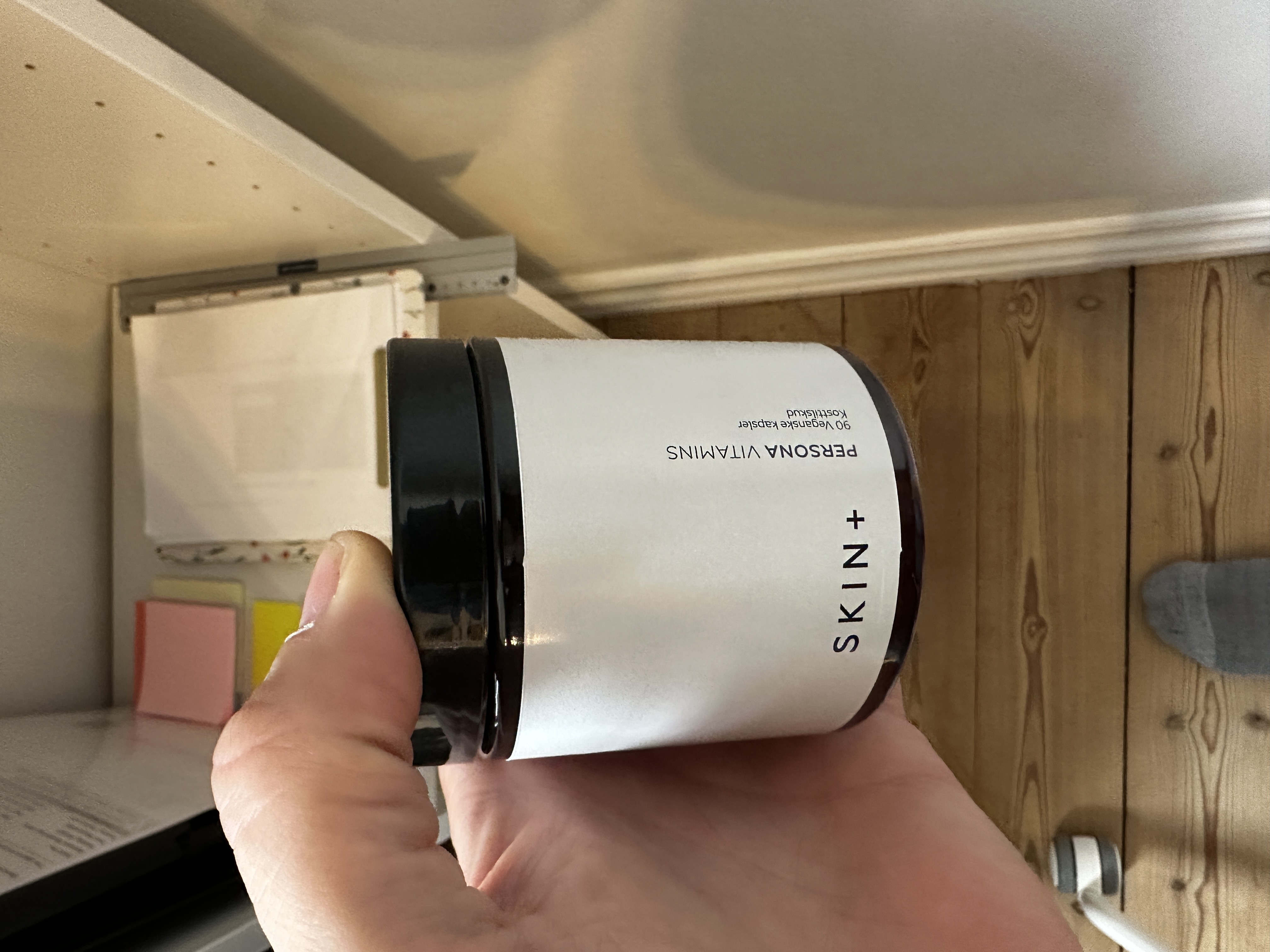
Loved it great experience
Thank you so much we are so pleased that you are happy with our product and service :) Have a great day!
Really great, high quality product. It actually smells like the sea but without any aftertaste. Love it!
Thank you so much we are so pleased that you are happy with our product and service :) Have a great day!
